
Let me be straight with you — I’ve paid for trading bot subscriptions that drained $80 a month while my trades barely broke even. That’s when I started digging into open-source alternatives. What I found changed how I trade completely.
If you’re here asking whether a free open source crypto trading bot can actually work, the answer is yes — and in many cases, it outperforms the paid ones. But it comes with a catch, and I’ll walk you through everything honestly.
Why People Are Moving to Open Source Trading Bots
Most beginners hit the same wall. They sign up for a paid crypto trading platform, chase a signal group, and then quietly lose money while the subscription bill keeps coming.
⚡ Featured Web3 Resource
Verify smart contracts, track on-chain assets, and audit token security instantly using our recommended platform.
Access Verified Web3 Tool →I’ve been there.
The shift to open source happened for me when a paid bot I used got shut down overnight. My API keys, my configuration, my strategy — all gone. No warning. That day, I realized I was building on someone else’s land.
Open-source bots give you:
- Full control of your own code
- Zero monthly subscription fee
- The ability to audit exactly what the bot does with your money
- A community of thousands of real traders is improving the same tool
If you care about liquidity in cryptocurrency and protecting your capital, handing that control to black-box software is never smart.
What Is a Crypto Trading Bot (and Do You Even Need One)?
A crypto trading bot is software that buys and sells crypto automatically based on rules you define. It watches the market 24/7, so you don’t have to sit in front of charts all night.
Here’s why that matters: crypto doesn’t sleep. Bitcoin moves at 3 AM. Altcoins spike on weekends. A bot catches those moves — a human usually doesn’t.
But here’s what most people don’t tell you: a bot doesn’t make you money on its own. It executes your strategy. If your strategy is bad, the bot just fails faster and more consistently than you would manually.
That’s actually why open source bots win here. You can backtest your strategy on years of historical data before touching a single dollar of real capital.
Is a Crypto Trading Bot Actually Profitable?
Yes — but with conditions. I’ve seen people run Freqtrade strategies that pulled consistent 3–8% monthly returns during sideways and bull markets. I’ve also seen people blow accounts in two weeks because they skipped backtesting and went live immediately.
The profitability isn’t in the bot. It’s in:
- Your strategy logic (entry/exit rules, indicators)
- Your risk management (stop-loss, position sizing)
- Market conditions (bots that work in bull markets can destroy you in a bear market)
If you want to understand the market mood before setting your bot live, keep an eye on the Crypto Fear and Greed Index — it tells you when the market is panicking or getting greedy, which directly affects how aggressive your bot should be.
My Personal Case Study
Early 2024. I set up Freqtrade on a $5/month VPS. Ran it on BTC/USDT and ETH/USDT pairs using a simple RSI + EMA crossover strategy. I backtested over 18 months of data.
First month: -2.4%. I thought I had failed.
I adjusted the hyperopt parameters, tightened my stop-loss, and removed two pairs that were dragging the strategy. Month two: +5.7%.
That was the lesson. Open source bots reward you for being patient and methodical. They don’t do magic. But once they’re dialed in? They just work — silently, consistently, and without emotion.
The 6 Best Open Source Crypto Trading Bots in 2026
1. Freqtrade — The Gold Standard
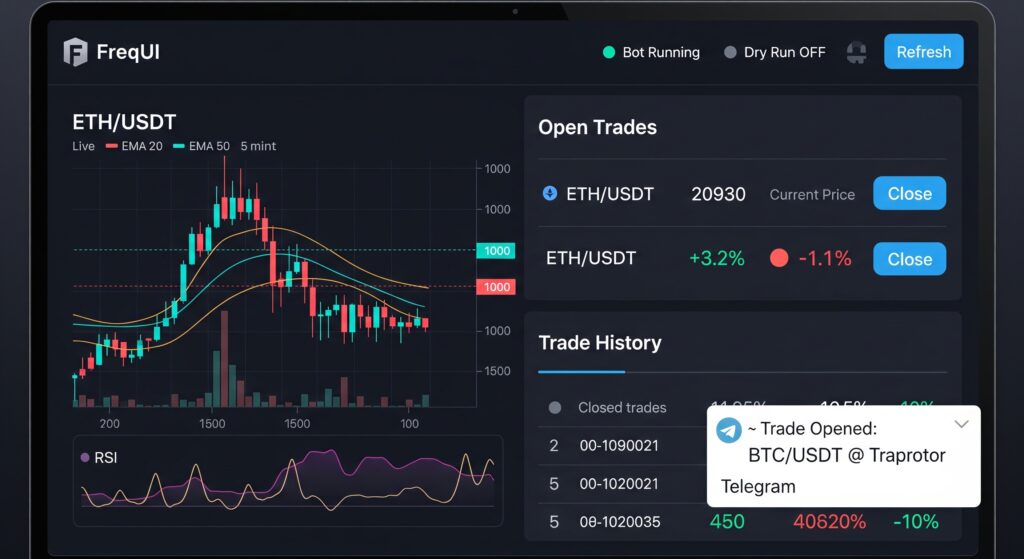
If there’s one name you remember from this whole article, make it Freqtrade.
Freqtrade is the most-starred crypto trading bot on GitHub — over 25,000 stars — and it earns that position. With an active release cycle now tracking the year (v2026.3 is the latest as of mid-2026), it’s the most actively developed and community-backed bot available.
I’ve used it personally, and it’s the one I keep coming back to.
What makes it special:
- Supports 30+ exchanges via CCXT, including Binance, Bybit, OKX, KuCoin, Kraken, Coinbase, and Hyperliquid (added 2026)
- Built-in FreqAI module — machine learning strategy optimization right out of the box
- Full backtesting engine with detailed metrics
- Controlled via Telegram or Web UI — you can manage your trades from your phone
- Runs on Windows, macOS, and Linux
Best for: Python developers and traders who want maximum control and customization.
Difficulty: Medium — you need basic Python knowledge, but their documentation is one of the best I’ve seen in open source.
Cost: 100% free. No paid tiers. No upsells.
2. OctoBot — Best for Beginners Who Don’t Code
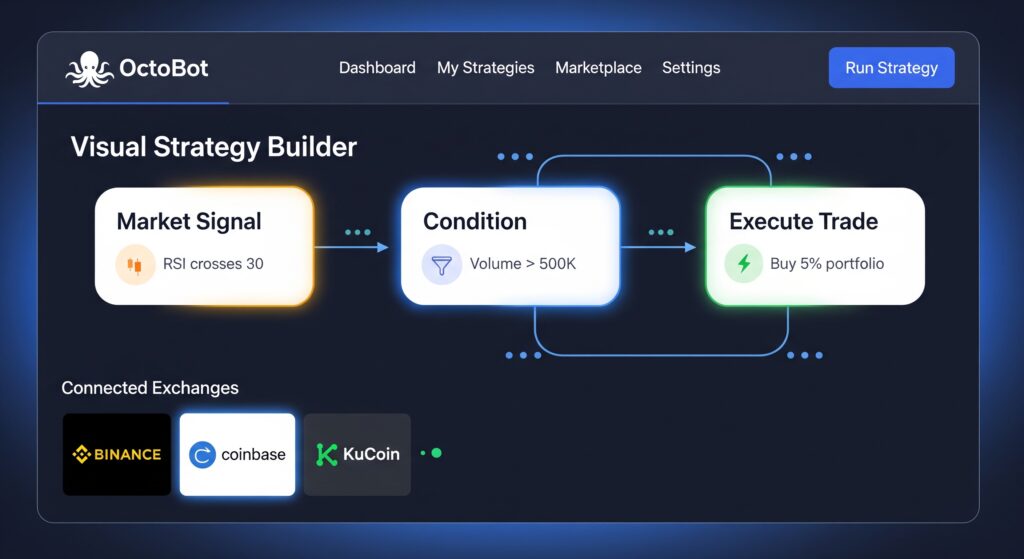
Not everyone is a developer. And OctoBot was built for exactly that person.
OctoBot is the easiest to set up — you can self-host it for free or access cloud plans from $9.99/month, and it supports 15+ exchanges with 40+ prebuilt strategies.
The visual strategy builder is genuinely impressive. You drag conditions onto a canvas, connect them, and the bot executes that logic. No terminal. No Python file.
What I liked:
- Plugin system — you extend it without touching the core code
- Active web UI that’s clean enough to show a friend without embarrassment
- Community strategy marketplace
Best for: Traders who want automation without the learning curve of programming.
Difficulty: Easy — the most beginner-friendly option on this list.
3. Hummingbot — For the Market Makers
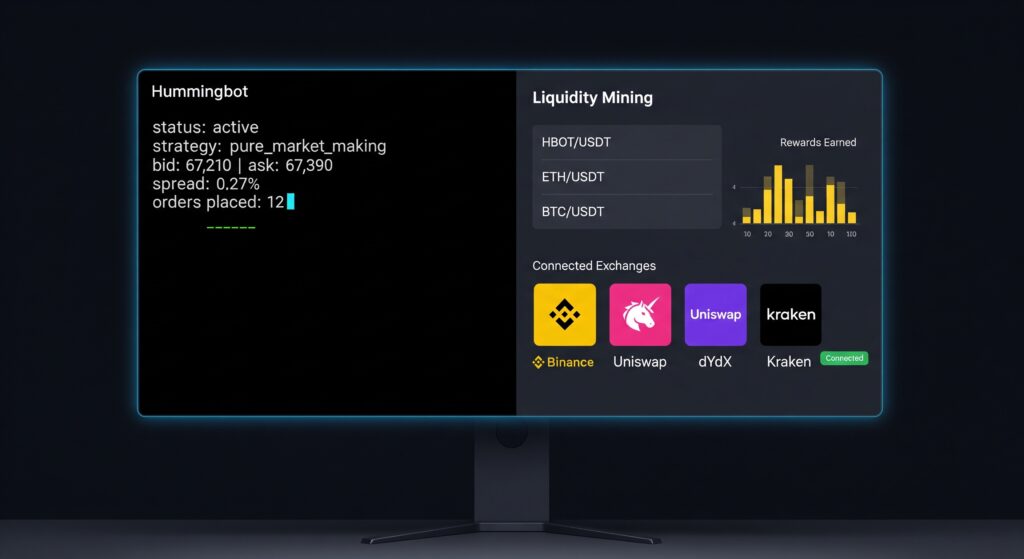
This one is different from everything else on the list. Hummingbot isn’t built for typical buy-low-sell-high trading. It’s built for market making — placing simultaneous buy and sell orders to profit from the spread.
Hummingbot is renowned for its automated trading strategies and compatibility with both centralized and decentralized exchanges. Its market-making feature is ideal for spread trading enthusiasts. The platform also supports liquidity mining, offering additional earning opportunities.
If you’re interested in the market cap dynamics of smaller tokens where spreads are wide, market making can be surprisingly profitable.
What stands out:
- Supports 20+ CEX and DEX platforms
- Liquidity mining — you earn rewards by providing liquidity
- Institutional-grade execution
Best for: Experienced traders interested in market-making and DeFi arbitrage.
Difficulty: High — this is not a beginner tool.
4. Jesse Bot — The Backtesting Powerhouse
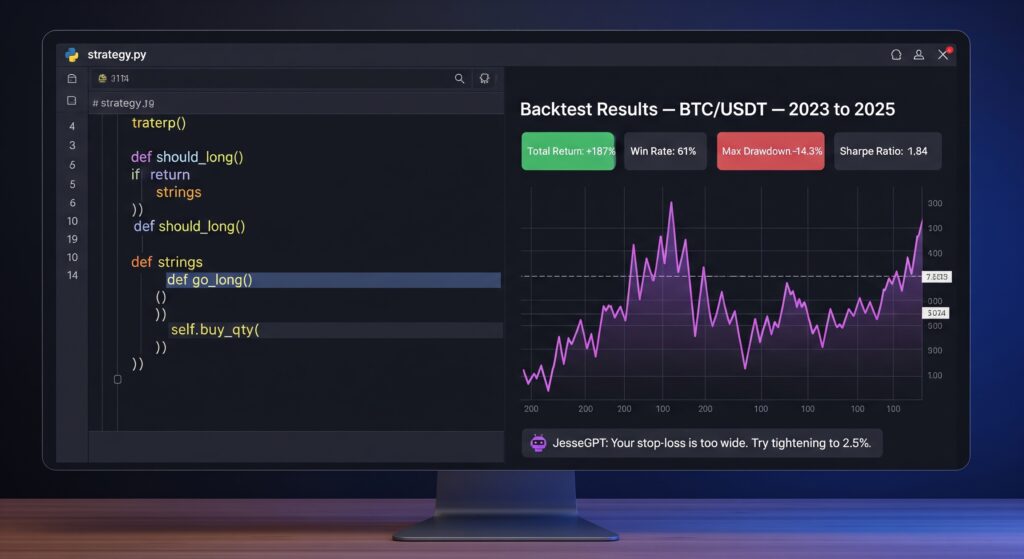
If you take strategy development seriously, Jesse will feel like a gift.
Jesse Bot is a free, open-source Python crypto trading bot and robust framework for cryptocurrency markets. You can build, backtest, AI-optimize, and execute precise automated strategies with zero look-ahead bias. It includes JesseGPT — a built-in AI assistant — to write, debug, and refine strategies effortlessly, even as a beginner.
The zero look-ahead bias point is a big deal. Many backtesting engines accidentally “peek” at future data, making strategies look better than they really are. Jesse eliminates that problem.
What I appreciate:
- Multi-timeframe and multi-symbol backtesting
- Custom indicators support
- Live trading on Binance and Bybit
- Full risk management and leverage/futures support
Best for: Quantitative traders who want research-grade backtesting accuracy.
Difficulty: Medium to High — Python required, but JesseGPT helps non-coders get started.
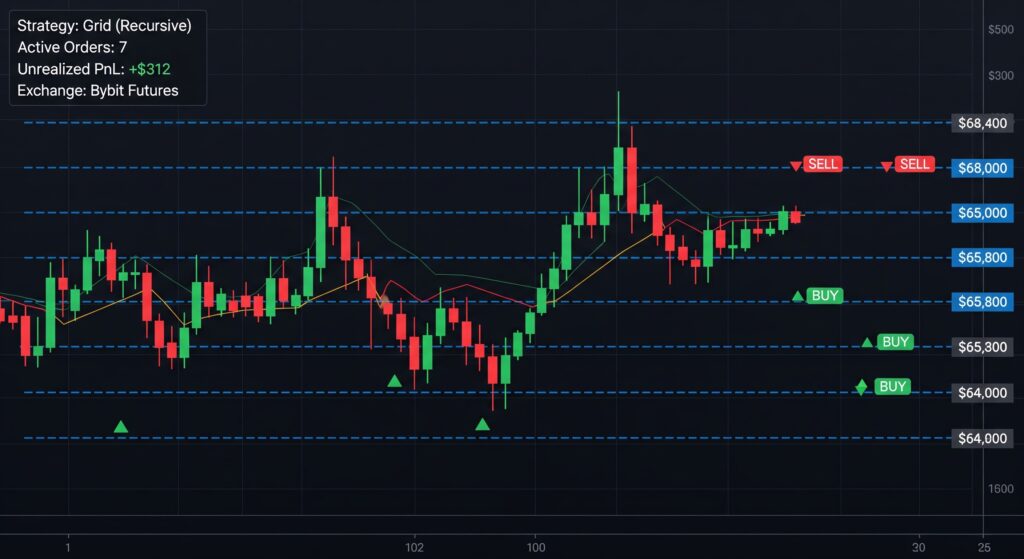
5. Passivbot — Automated Grid Trading, Simplified
📸 IMAGE PROMPT: Passivbot grid trading visualization on a BTC/USDT perpetual futures chart. Grid lines shown at different price levels with automated buy/sell markers. Dark background with grid overlay.
Alt Text: Passivbot open source crypto grid trading bot on perpetual futures chart
What works well:
- Fully automated grid configuration
- Supports recursive and neat grid modes
- Active Telegram community sharing optimized configs
- 100% free and open source
Best for: Traders who want to profit in ranging, non-trending markets.
Difficulty: Medium — requires understanding of futures and grid logic before going live.
⚠️ Grid bots on futures carry liquidation risk if the market moves sharply against your range. Always use proper risk management and consider your crypto wallet setup and exchange allocation carefully.
6. Superalgos — The Most Ambitious Project
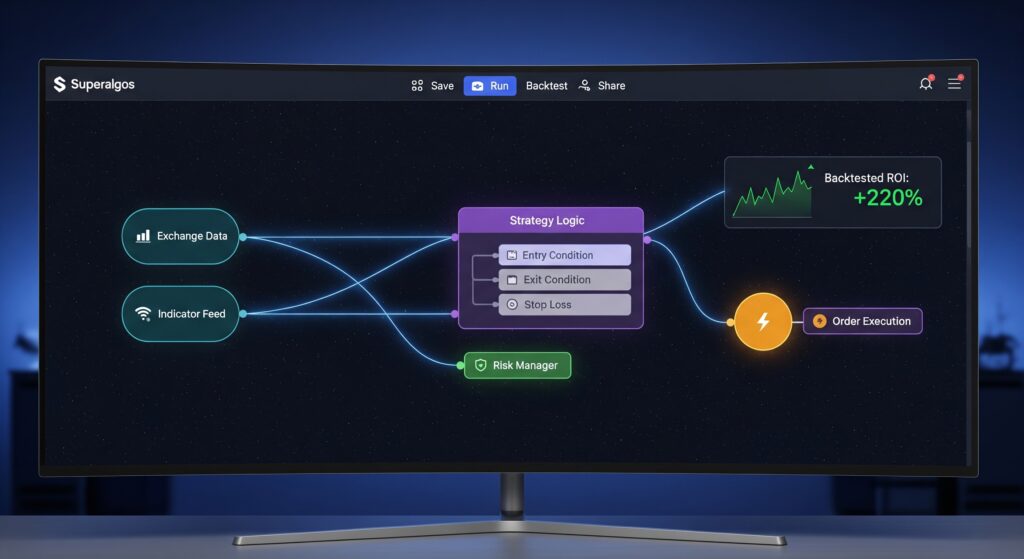
Superalgos is unlike anything else on this list. It’s not just a trading bot — it’s an entire ecosystem for building, sharing, and trading strategies collaboratively.
Think of it as the open source version of Bloomberg Terminal — ambitious, powerful, and a little overwhelming at first.
What makes it unique:
- Visual node-based strategy designer (no code required for basic strategies)
- Built-in data mining and social trading layer
- Token-based governance (community owns the platform)
- Supports multiple exchanges simultaneously
Best for: Power users who want to build complex, multi-exchange automated systems.
Difficulty: High — expect a steep learning curve.
Comparison Table
| Bot | Best For | Difficulty | Cost | Coding Required |
|---|---|---|---|---|
| Freqtrade | All-around trading | Medium | Free | Yes (Python) |
| OctoBot | Beginners | Easy | Free / $9.99+ cloud | No |
| Hummingbot | Market making | High | Free | Partial |
| Jesse Bot | Backtesting | Medium-High | Free | Yes (Python) |
| Passivbot | Grid trading (futures) | Medium | Free | No |
| Superalgos | Complex multi-exchange | High | Free | Optional |
How to Set Up Your First Open Source Bot (The Honest Way)
Here’s what I wish someone had told me when I started:
Step 1 — Don’t go live immediately. Every single one of these bots supports dry run mode — simulated trading with no real money. Run it for at least 2–4 weeks first.
Step 2 — Backtest before anything. Use at least 6–12 months of historical data. A strategy that only works on 2 weeks of data is not a strategy.
Step 3 — Host it properly. Self-hosting an open source trading bot requires a server that runs continuously. Most traders use a Linux-based VPS from providers like AWS, DigitalOcean, or Hetzner. A basic setup with 2 CPU cores, 4GB RAM, and 40GB storage is sufficient for running a single bot instance. Costs range from $5 to $40 per month.
Step 4 — Use Dollar Cost Averaging principles in your bot strategy. Instead of going all-in at once, let the bot accumulate positions gradually.
Step 5 — Start with proven strategies. The Freqtrade community has hundreds of strategies you can use as templates before writing your own.
Are These Bots Safe?
Open-source bots are generally safer because anyone can audit the code. Your API keys stay on your own server when self-hosting. The main risk is misconfiguring your trading strategy, not the software itself.
One important rule: never give your API keys withdrawal permissions. Trade permissions only. This way, even if something goes wrong, no one can pull funds out of your exchange account.
Also, make sure you’re using a secure crypto wallet for funds you’re not actively trading — never keep everything on an exchange.
FAQ
What is the best free crypto trading bot in 2026? Freqtrade is the most widely used and community-supported free open source crypto trading bot. For beginners, OctoBot is the easiest to start with.
Can I use a crypto trading bot without coding? Yes. OctoBot and Superalgos offer visual builders. Passivbot also works without deep coding knowledge once configured.
Is Freqtrade really free? 100% free. No subscription, no premium tier, no limits. You only pay for the VPS server you choose to host it on.
What is the best open source AI crypto trading bot? Freqtrade with FreqAI and Jesse Bot with JesseGPT are the two strongest AI-powered options right now.
Do I need to know Python to use these bots? For Freqtrade, Jesse, and Hummingbot — yes, at least the basics. For OctoBot and Passivbot — no. For Superalgos — optional.
What exchange should I connect my bot to? Binance and Bybit are the most supported across all these bots. For investing in Bitcoin with a bot strategy, these two offer the best liquidity and API reliability.
Final Thought
I know it can feel like everyone else has some secret edge in crypto. But here’s what I’ve learned after years in this space: the edge is discipline, not tools.
An open source trading bot doesn’t guarantee profits. What it does give you is consistency, 24/7 execution, and the ability to remove emotion from your trades. Pair that with a backtested strategy, proper risk management, and the patience to improve over time — and you’ve got something real.
You don’t need to pay $100 a month for automation. The best tools are free, transparent, and trusted by thousands of traders who’ve been using them far longer than most paid platforms have even existed.
Pick one bot. Start in dry-run mode. Learn it properly. Then let it work for you.
That’s not a guarantee. But it’s exactly how I did it — and it changed everything.
External Reference: Freqtrade Official Documentation — the most complete resource for getting started with the bot.
External Reference: GitHub — Hummingbot Repository — full source code, issues, and community discussions.

Ammar Malik is an independent digital asset researcher and the founder of AmmarMagazine. He specializes in analyzing on-chain security and evaluating technical tools. Through clear, objective crypto resources, Ammar Malik delivers accessible Web3 education to help everyday users navigate the market safely.