Most people who are new to crypto ask one question before anything else. Where do my coins actually go?
That’s the right question. And the honest answer is — your coins don’t “go” anywhere in the physical sense. They live on the blockchain. But you need something to access them, prove you own them, and move them when you want. That something is your crypto wallet.
Think of it like this: your bank stores your money. But your wallet stores your access. Without it, you can’t touch a single satoshi.
⚡ Featured Web3 Resource
Verify smart contracts, track on-chain assets, and audit token security instantly using our recommended platform.
Access Verified Web3 Tool →I remember when I first bought Bitcoin back in the early days. I just left it on the exchange and thought, “It’s safe, it’s digital, no one can take it.” Then I watched an exchange get hacked, and thousands of users lost everything overnight. That was my wake-up call. I moved everything into a cold storage wallet the next day and never looked back.
Why People Are Shifting to Crypto — And Why Wallets Matter
Before we get into the what, let me tell you the why behind crypto wallets.
People are moving to crypto because they’re tired of being told what to do with their own money. Banks freeze accounts. Governments devalue currencies. Payment processors block transactions. Crypto was built as the answer to all of that.
But here’s the part most beginners miss — if you’re keeping your crypto on an exchange, you don’t actually own it. The exchange does. You just have an IOU. A real crypto wallet changes that. It gives you self-custody, meaning you and only you control your funds.
Everyone who takes crypto seriously eventually makes this shift. Not because someone told them to. Because they either learned the hard way or were smart enough to learn from someone who did.
So What Is a Crypto Wallet, Exactly?
A crypto wallet is a software or hardware tool that stores your private keys and lets you interact with the blockchain. It doesn’t store your actual coins — the coins stay on the blockchain. The wallet stores the keys that prove you own those coins.
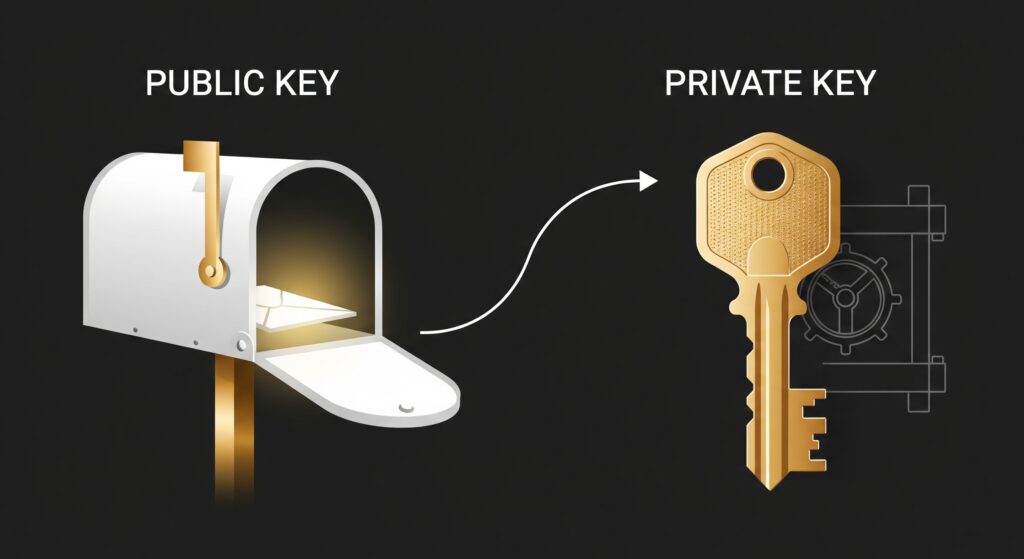
There are two keys you need to understand:
- Public Key — This is your wallet address. Think of it like your email. Share it to receive funds.
- Private Key — This is your password to the vault. Never share it. Lose it, and your funds are gone forever.
That’s it. Simple when you strip away the jargon.
What Is a Crypto Wallet Used For?
People use a crypto wallet for more than just storing Bitcoin. Here’s what it actually does in real life:
- Sending and receiving crypto — whether it’s Bitcoin, Ethereum, or any altcoin
- Connecting to DeFi platforms — staking, lending, liquidity pools, yield farming
- Accessing Web3 apps — NFTs, decentralized games, DAOs
- Swapping tokens — without going through a centralized exchange
- Signing transactions — proving on the blockchain that you authorized a payment
When you connect your wallet to a platform like Uniswap or OpenSea, you’re not logging in with a username — you’re signing in with your wallet. That’s what a Web3 wallet for crypto actually means.
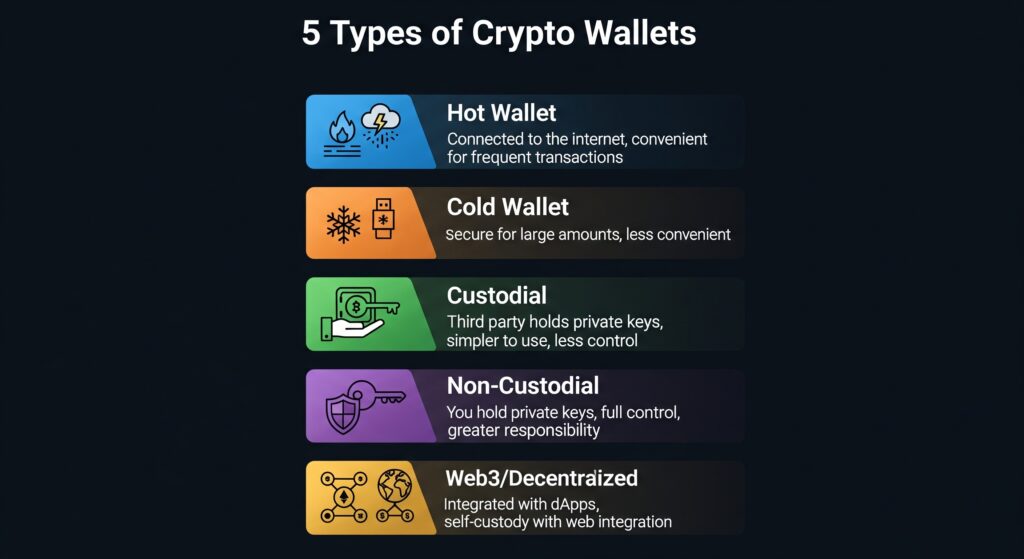
What Are the 5 Types of Cryptocurrency Wallets?
Not all wallets are the same. I’ve personally used most of them at different stages, and each one has its place depending on what you’re doing.
1. Hot Wallets (Software Wallets)
These are connected to the internet. Easy to use, fast, and perfect for day-to-day transactions. The trade-off? They’re more vulnerable to hacks.
Popular hot wallets include Exodus, Crypto.com, and MetaMask.
If you’re actively trading or using DeFi apps, a hot wallet makes sense. But don’t keep your life savings in one.
2. Cold Storage Wallets (Hardware Wallets)
This is where serious investors keep the bulk of their holdings. A cold storage crypto wallet is a physical device — like a USB stick — that stores your private keys completely offline.
The two most trusted ones in the market right now are the Ledger hardware wallet and the Trezor hardware wallet. I personally use Ledger for long-term holdings and have for years. It’s the closest thing to a physical vault you’ll get in crypto.
If you’re serious about protecting your assets, this is non-negotiable.
3. Custodial Wallets (Exchange Wallets)
These are wallets managed by an exchange, like eToro wallet, Kraken wallet, or Robinhood crypto wallet. You sign up, they handle the keys, and you get a clean interface.
Convenient? Yes. Safe for large holdings? Absolutely not. Remember: not your keys, not your coins.
4. Non-Custodial Wallets
A non-custodial wallet (also called a self-custody wallet) gives you full control. You hold the private keys. No third party involved. This is the gold standard for anyone serious about crypto security.
Examples include ZenGo wallet, blockchain.com wallet, and crypto.com DeFi wallet.
5. Decentralized / Web3 Wallets
A decentralized crypto wallet lets you connect directly to decentralized applications without any middle party. Think of wallets like MetaMask or a crypto DeFi wallets—they’re the bridge between you and the entire Web3 world.
If you’re exploring DeFi, this is the type you’ll be using the most.
What Is the Safest Crypto Wallet?
Here’s my honest answer: the safest crypto wallet is the one you actually use correctly.
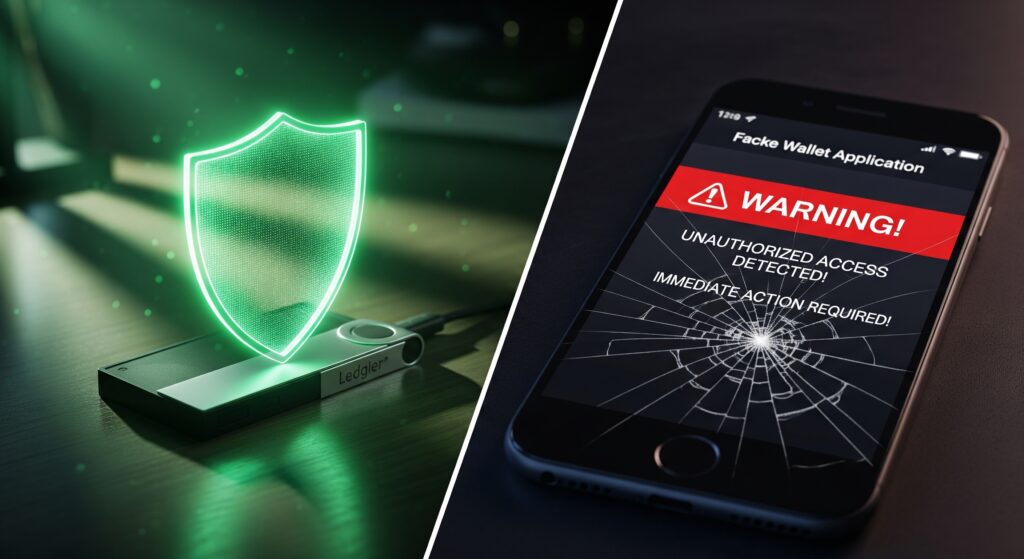
That said, if we’re talking pure security, a cold storage crypto wallet like Ledger or Trezor wins every time. Your private keys are stored offline. No hacker can touch what isn’t connected to the internet.
But here’s what I’ve seen people do wrong — they buy a hardware wallet, lose the seed phrase (the 12 or 24 recovery words), and end up locked out forever. No support team can help you. There is no “Forgot Password” button in crypto.
The safest wallet = cold storage + seed phrase stored in a safe physical location.
What Is the Best Crypto Wallet?
That depends on what you’re doing.
| Use Case | Best Wallet Type | Example |
|---|---|---|
| Long-term holding | Cold Storage | Ledger, Trezor |
| Daily trading | Hot Wallet | Exodus, crypto.com wallet |
| DeFi / Web3 | Non-Custodial | MetaMask, ZenGo |
| Beginners | Custodial | eToro, Robinhood |
| Multi-coin storage | Multi-currency | Exodus, Trust Wallet |
The best multi-cryptocurrency wallet for most beginners is Exodus — it’s clean, supports hundreds of coins, and has built-in swap features. For advanced users going deep into Web3, MetaMask is the standard.
My Personal Case Study: What I Got Wrong
When I first started, I had three wallets spread across two exchanges and one soft wallet. No backup. No seed phrase written down. Just vibes.
Then my laptop crashed.
I lost access to one wallet completely. The coins weren’t gone — they were still on the blockchain — but I had no private key, no seed phrase, nothing. I had to watch that wallet sit there with a balance I couldn’t touch.
It was the most expensive lesson I’ve ever learned, and I didn’t even technically “lose” the coins. I just lost access.
Since then, I’ve been obsessive about wallet hygiene:
- Hardware wallet for main holdings
- Seed phrase written in two physical locations
- Hot wallet only for small amounts; I’m actively using it
Don’t be me from 2019. Set it up right the first time.
Is a Crypto Wallet Safe?
It can be extremely safe — or dangerously vulnerable. It depends entirely on how you use it.
Here’s what puts people at risk:
- Sharing or storing a private key digitally (screenshots, cloud storage, email)
- Using a fake wallet app downloaded from unofficial sources
- Falling for phishing links that imitate real wallet sites
- Ignoring software updates on hot wallets
- Not backing up the seed phrase
And here’s what makes a wallet truly secure:
- Cold storage for large holdings
- Non-custodial setup, so you control the keys
- Seed phrase written on paper, stored offline
- Two-factor authentication is available
An online crypto wallet is convenient, but it carries risk. If you understand market risks in crypto, then you already know — the biggest risks aren’t always price swings. Sometimes it’s human error.
What Is a Crypto Wallet Address?
Your crypto wallet address is a string of letters and numbers — usually 26 to 35 characters long — that acts as your public identity on the blockchain.
Think of it like your home address. People can send packages (crypto) to it, but they can’t walk in. Only you hold the key to do that.
Every blockchain has its own address format:
- Bitcoin addresses start with
1,3, orbc1 - Ethereum addresses start with
0x - Solana addresses are base-58 encoded strings
Always double-check the address before sending anything. Sending crypto to the wrong address is permanent. There’s no undo button.
Crypto Wallets and DeFi: The Real Connection
If you’re planning to go beyond just holding Bitcoin, you’ll need to understand how wallets connect to the broader DeFi world.
A DeFi wallet like crypto.com’s DeFi wallet, MetaMask, or Trust Wallet connects you directly to decentralized protocols. You can:
- Stake assets and earn passive rewards
- Provide liquidity to earn fees
- Borrow against your holdings
- Participate in token launches
The crypto DeFi wallet from Crypto.com is worth mentioning specifically — it lets you access DeFi while still having the user-friendliness of a branded product. It’s a solid middle ground for people who want DeFi exposure without the complexity of pure MetaMask setups.
And if you’re using platforms like MoonPay wallet for buying crypto with a debit or credit card, the funds usually land in a custodial wallet first — you’d want to move them to a non-custodial or hardware wallet for real safety.
How Does a Crypto Wallet Work?
Quick breakdown of the flow:
- You create a wallet → a public/private key pair is generated
- You receive a seed phrase (backup code) → this is your master key
- Your wallet address goes public → people can send you crypto
- When you send crypto → your wallet signs the transaction with your private key
- The blockchain verifies the signature → transaction is confirmed
It’s all cryptography under the hood. The wallet just makes that process human-friendly.
For a deeper look at how transactions get recorded, check out the article on what is blockchain — it connects everything here.
Crypto Wallet Examples Worth Knowing
Here’s a quick reference of wallets people actually use:
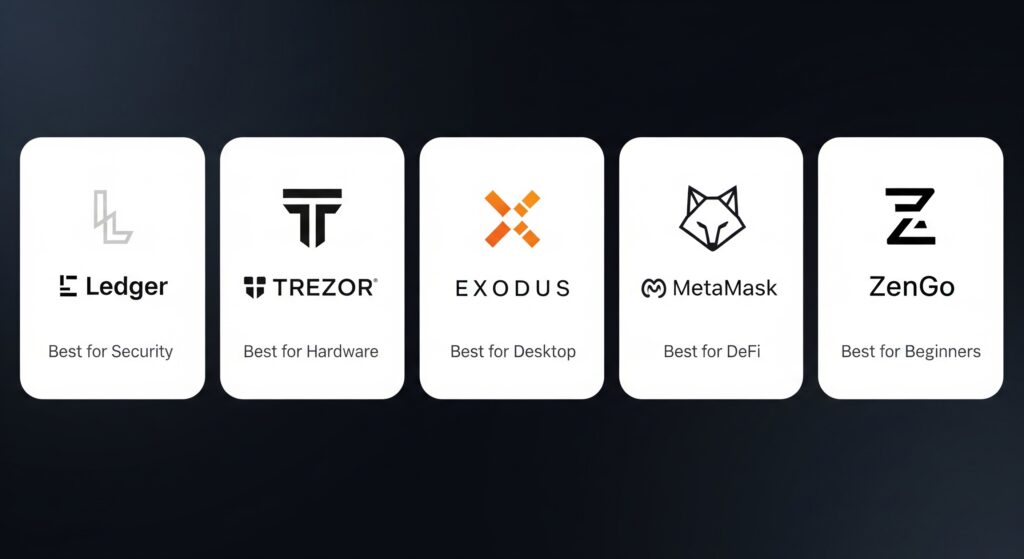
- Ledger hardware wallet — best cold storage, industry standard
- Trezor hardware wallet — open-source cold wallet alternative
- Exodus crypto wallet — best desktop/mobile hot wallet
- ZenGo wallet — beginner-friendly, keyless security model
- Crypto.com wallet — for Crypto.com ecosystem users
- Blockchain.com wallet — one of the oldest online wallets
- eToro wallet — good for beginners already on eToro
- Robinhood crypto wallet — familiar for stock investors crossing into crypto
- Kraken wallet — exchange-linked, solid security reputation
- Fidelity crypto wallet — for institutional and traditional investors entering crypto
Each one has its strength. The key is matching the wallet to your strategy — not just picking the most popular one.
Before You Pick a Wallet — Ask These Questions
Not every wallet works for every person. Before you download or buy anything, think through this:
- How much are you holding? Large amounts = hardware wallet. Small amounts = hot wallet is fine.
- Are you actively trading? Yes = hot wallet. Holding long-term? = cold storage.
- Are you using DeFi? Yes = non-custodial Web3 wallet.
- Are you a complete beginner? Yes = start with a custodial wallet on a reputable exchange while you learn.
The goal is to graduate. Start with what you understand. Then, as your holdings grow and your knowledge grows, shift toward a self-custody wallet setup.
And if you’re still figuring out whether you should invest in crypto at all — that’s a question worth answering before you set up any wallet.
FAQ: What You’re Probably Still Wondering
Can I have more than one crypto wallet?
Yes, and most serious investors do. They typically keep a cold storage wallet for savings and a hot wallet for active use.
What happens if I lose my crypto wallet?
The wallet itself doesn’t matter — as long as you have your seed phrase. Enter the seed phrase into any compatible wallet, and you recover full access.
Can someone hack my crypto wallet?
A hardware wallet that’s offline? Nearly impossible. A hot wallet with poor security practices? Very possible. Security depends on behavior, not just tools.
Do I need a separate wallet for each cryptocurrency?
Not necessarily. Most modern multi-cryptocurrency wallets like Exodus support hundreds of coins in one place.
Is a crypto wallet the same as an exchange account?
No. An exchange account is custodial — the exchange holds your keys. A wallet puts you in control.
What is the difference between a hot wallet and a cold wallet?
Hot wallets are connected to the internet (convenient, slightly riskier). Cold wallets are offline (more secure, less convenient). Understanding the market will tell you when each makes more sense.
Final Thought
Your wallet is not just a technical tool. It’s a statement. It says, “I take ownership of my money seriously.”
Every pro in this space — every person who’s built real wealth through crypto — eventually makes the same move. They stop relying on exchanges. They stop trusting platforms to hold what belongs to them. They get a real wallet, back it up properly, and take control. You don’t have to be technical to do this. You just have to take it seriously once.
Start simple. Learn the basics. Move your holdings off exchanges when you’re ready. And for anything long-term and meaningful — get a hardware wallet. Your future self will thank you for it.

Ammar Malik is an independent digital asset researcher and the founder of AmmarMagazine. He specializes in analyzing on-chain security and evaluating technical tools. Through clear, objective crypto resources, Ammar Malik delivers accessible Web3 education to help everyday users navigate the market safely.