
Short answer first — blockchain is a shared digital record book that thousands of computers maintain at the same time. Every entry in it is permanent. Anyone can read it. And nobody — not a bank, not a government, not even the person who created it — can go back and change what’s already written. That’s the “what.” The “how it works for you” part is even simpler: every time you buy Bitcoin, send crypto, or use any decentralized app — blockchain is quietly recording that transaction in a way that can’t be faked or reversed. You didn’t see it happening. But it happened. And once you understand what’s going on underneath all of that, you’ll never look at a crypto investment the same way again.
Why You Should Even Care About This
Nobody gets curious about database technology for fun. You’re probably here because you’re already in crypto — or seriously thinking about it — and “blockchain” keeps coming up without anyone actually explaining what it means. So let me tell you something I wish I’d heard earlier.
You don’t invest in crypto. You invest in blockchains.
⚡ Featured Web3 Resource
Verify smart contracts, track on-chain assets, and audit token security instantly using our recommended platform.
Access Verified Web3 Tool →Every coin runs on a blockchain underneath it. Bitcoin has the Bitcoin blockchain. Ethereum has its own. Every altcoin, every DeFi token — all of it lives on blockchain infrastructure. So when you buy a coin, you’re really betting on that blockchain. Its security, its adoption, whether real developers are building on it, whether real people are actually using it.
My first year in crypto, I completely ignored all of that. I looked at price charts and community hype. Some coins did well. Most didn’t survive the next bear cycle. When I looked back at what made the difference, the projects that survived had real, solid blockchain infrastructure underneath. The ones that died were tokens sitting on borrowed technology with nothing genuine holding them up.
Understanding blockchain didn’t make me a developer. It just made me ask better questions before putting money anywhere.
And if you want to see how this connects to real investment decisions — the market cap of any crypto project is really just a reflection of how much the market values the blockchain running underneath it. That one insight changes how you read market data completely.
What Is Blockchain in Simple Words — No Jargon
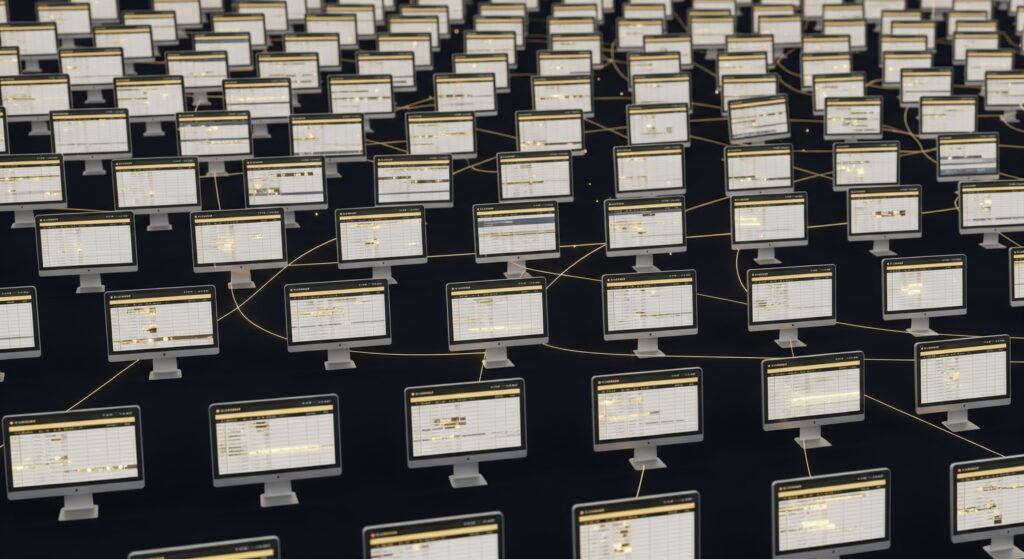
Forget the technical language for a moment. Imagine a spreadsheet that records every financial transaction — who sent money, who received it, how much, and when. Normal stuff. Now imagine that same spreadsheet is copied across 10,000 computers at the same time. Every time a new transaction gets added, all 10,000 computers update together. And a transaction only gets added if the majority of those computers agree it’s genuine.
Now — the part that makes this unlike anything that came before it.
Once a transaction is recorded, nobody can change it. Not the sender, not the receiver, not a bank, not a government. Change it on one computer, and it immediately conflicts with the other 9,999 copies. The network sees the mismatch and rejects it. Just like that.
That’s blockchain in simple words. A shared record that everyone can read, nobody owns, and nobody can secretly edit.
Want it even simpler? Blockchain for dummies — a record book written in permanent ink, copied 10,000 times the moment anything is written in it, and readable by anyone but erasable by nobody.
In computer terms, it’s called a distributed ledger. A database that lives across thousands of machines with no single administrator running the show.
What’s Actually Inside a Block?
Each “block” in the chain holds three things.
Transaction data. The actual record — who sent what to whom, when, and how much.
A hash. Think of this as a fingerprint unique to that block. It gets generated mathematically from the block’s contents. Change even one character inside the block, and the hash changes completely. The network spots the difference instantly.
The previous block’s hash. This is what creates the chain. Every block carries the fingerprint of the block before it. Try to alter an old record, and you break that block’s fingerprint — which breaks its connection to every block after it. To successfully rewrite history, you’d need to recalculate every block that followed — faster than the entire rest of the network is adding new ones. With Bitcoin’s network running the way it does, that’s not realistically possible.
So What Is a Blockchain Node?
A node is any computer that participates in the network, keeping a copy of the full ledger and helping verify new transactions. More nodes mean more decentralization, which means it’s harder to compromise.
Bitcoin runs on tens of thousands of active nodes spread across the globe. No central server to hack. No single point that an attacker could take down. That’s why it’s still running cleanly after 15 years without a successful breach.
Whenever you see a project claiming to be “decentralized,” the first thing worth checking is the node count. A blockchain with 15 nodes is one coordinated decision away from being controlled by someone. That’s not decentralization. That’s a marketing claim.
What Is Blockchain in Crypto — Your Real Connection to It

Everything you do in crypto connects back to the blockchain directly.
What is a blockchain wallet? This surprises most people. Your crypto wallet doesn’t actually hold your coins. It holds your private key — the cryptographic proof that you own those coins on the blockchain. The coins themselves exist as entries in the blockchain ledger. Your wallet is just the tool you use to access and move them.
This is exactly why leaving Bitcoin on an exchange is genuinely risky. The exchange holds your private key on your behalf. If the exchange freezes withdrawals, gets hacked, or shuts down, your key goes with it. I went deep on this in my piece on investing in Bitcoin — it’s one of the three mistakes that cost people the most.
What is a blockchain explorer? Think of it as a search engine that lets you look up any transaction, any wallet address, and any block in the chain’s entire history. Etherscan for Ethereum. Blockchain.com for Bitcoin. Every transaction ever made on a public blockchain is sitting there, searchable, right now, by anyone.
That transparency is what makes blockchain actually trustworthy. Not a company’s promise or a terms-of-service agreement. A public record that anyone can verify at any time.
What Is Blockchain Used For — Beyond Just Crypto
Blockchain isn’t only a Bitcoin thing. Most people don’t realize how far it goes.
Supply chain — Walmart uses blockchain to trace food products from farm to shelf. A contamination issue that used to take days of phone calls now gets traced in seconds.
Healthcare — medical records stored on blockchain give patients real ownership of their own data. Shareable with any doctor using cryptographic permission. No more records disappearing between hospitals.
Real estate — property title transfers on blockchain cut out title companies, reduce fraud, and collapse a weeks-long process into hours.
Smart contracts — programs stored on a blockchain that run automatically when conditions are met. A loan repaid triggers automatic collateral release. An NFT sold triggers an automatic royalty payment to the creator. No lawyer, no intermediary, no human approval sitting in the middle. The code executes exactly as written.
DeFi — the entire ecosystem of financial products built on smart contracts. Lending, borrowing, trading — open to anyone with a wallet, running around the clock. The crypto liquidity powering these protocols comes from users depositing into smart contract pools — not from any bank’s reserves.
What Is Blockchain in Business
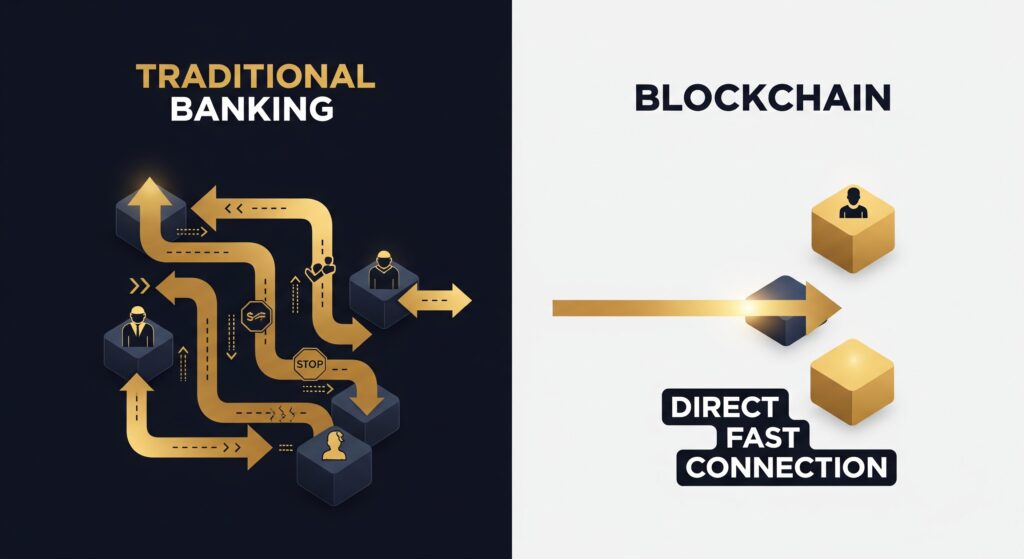
In business terms, blockchain replaces trust in institutions with trust in code.
Every business transaction currently runs through layers of verification. Banks confirm payments. Lawyers check contracts. Auditors review records. Each layer adds cost, time, and a human being who could make an error or act in their own interest.
| Traditional Banking | Blockchain | |
|---|---|---|
| Transaction time | 1–5 business days | Minutes |
| Operating hours | Business hours | 24/7/365 |
| Middlemen | Multiple | None |
| Fees | 1–7% | Fractions of a percent |
| Transparency | Private | Public and auditable |
Is blockchain safe? The blockchain layer itself — yes, remarkably so. Bitcoin’s blockchain has never been breached in over 15 years of continuous operation. What get compromised are the applications sitting on top — exchanges, wallets, and smart contracts with coding mistakes. The base layer has a security record that no traditional bank can point to.
What Is a Blockchain Developer
Two types. Very different work.
Core developers build and maintain the protocol itself. The consensus rules, security architecture, and network logic. Think of the people working on Bitcoin Core.
Application developers build the products that run on existing blockchains. DeFi protocols, wallets, NFT platforms, smart contracts. Most commercial blockchain work happens at this level.
The main language for Ethereum smart contracts is called Solidity. Ethereum.org’s developer documentation (external link — place here) is genuinely the best free starting point — it’s where most working blockchain developers began learning.
Demand for blockchain developers stays consistently ahead of supply. The technical barrier keeps the talent pool smaller than the industry needs, which is why salaries stay strong for anyone who gets through it.
5 Questions I Ask Before Investing in Any Crypto Project

This is where understanding blockchain actually pays off. Before putting money into any project, these are the five things I check now.
Does it have its own blockchain, or is it just a token on someone else’s? A project with its own blockchain made a real technical commitment. A token sitting on borrowed infrastructure can be abandoned quietly overnight.
How many active nodes does it have? More nodes mean more genuine decentralization. Check this before trusting anything that calls itself decentralized.
Is there consistent developer activity on GitHub? Active commits mean real builders. A repository that hasn’t been updated in months tells you everything you need to know — regardless of what the price is doing.
Does the use case actually need a blockchain? If a normal database would solve the problem just as well, the blockchain is a marketing prop. Marketing props don’t survive bear markets.
What does the on-chain transaction volume look like? The blockchain.com explorer shows you real activity. Price can be pushed around. On-chain volume at scale is much harder to fake.
Pair these questions with knowing where we are in the bear and bull market cycle, and you have both a quality filter and a timing framework working together. That combination is genuinely rare among retail investors.
FAQ — Real Questions, Straight Answers
What is blockchain in simple words?
A shared record book that thousands of computers maintain at once. Every entry permanent. Nobody is in control alone. Nobody can erase it.
What is blockchain technology used for?
Crypto transactions, DeFi, supply chains, medical records, property titles, voting, NFTs, and smart contracts. Any situation where you need a permanent shared record without trusting a single institution to keep it honest.
What is a block in a blockchain?
A container with three things inside — the transaction data, a unique hash fingerprint, and the previous block’s hash. That chain of connected fingerprints is what makes tampering with old records practically impossible.
What is a blockchain node?
A computer participating in the network by holding a copy of the ledger and helping verify new transactions. More nodes, more security, more genuine decentralization.
What is a blockchain wallet?
It stores your private key — not your coins. Your coins live on the blockchain. The wallet is how you prove ownership and move them.
What is a blockchain explorer?
A public search tool for the blockchain. Look up any transaction, wallet, or block in the chain’s entire history. Open to anyone, anytime.
What is a blockchain ledger?
The full sequential record of every block ever added — going all the way back to the very first one, called the genesis block. Distributed across every node. Never altered. Never deleted.
Is blockchain safe?
The blockchain itself — yes. Bitcoin’s base layer has run for over 15 years without a successful attack. The risk comes from what’s built on top — exchanges, wallets, and smart contracts that carry their own separate vulnerabilities.
What is blockchain in crypto investing?
The infrastructure underneath whatever coin you’re buying. Understanding whether a blockchain has real utility, real developers, and real adoption is the difference between informed investing and guessing.
How is blockchain different from a regular database?
A regular database is controlled by whoever owns the server — they can edit or delete records whenever they want. A blockchain follows consensus rules. Nobody changes it unilaterally. That’s a genuinely new kind of record system.
What is a blockchain developer?
Someone building on blockchain — either at the protocol level (the rules and architecture) or the application level (DeFi, wallets, smart contracts).
What is blockchain for dummies?
A record book written in permanent ink, copied 10,000 times the moment anything is added, is readable by anyone and erasable by nobody.
Final Thought
Blockchain isn’t complicated. It’s a permanent shared record controlled by math instead of people. That’s the whole thing.
But the real takeaway isn’t the technology. It’s what knowing this does for you. Most people in crypto are betting on price. You’re now in a position to bet on substance — on whether the blockchain underneath a project is real, functional, growing, and actually needed.
That’s not a small edge.
The technology doesn’t care if you understand it. But your portfolio does.

Ammar Malik is an independent digital asset researcher and the founder of AmmarMagazine. He specializes in analyzing on-chain security and evaluating technical tools. Through clear, objective crypto resources, Ammar Malik delivers accessible Web3 education to help everyday users navigate the market safely.