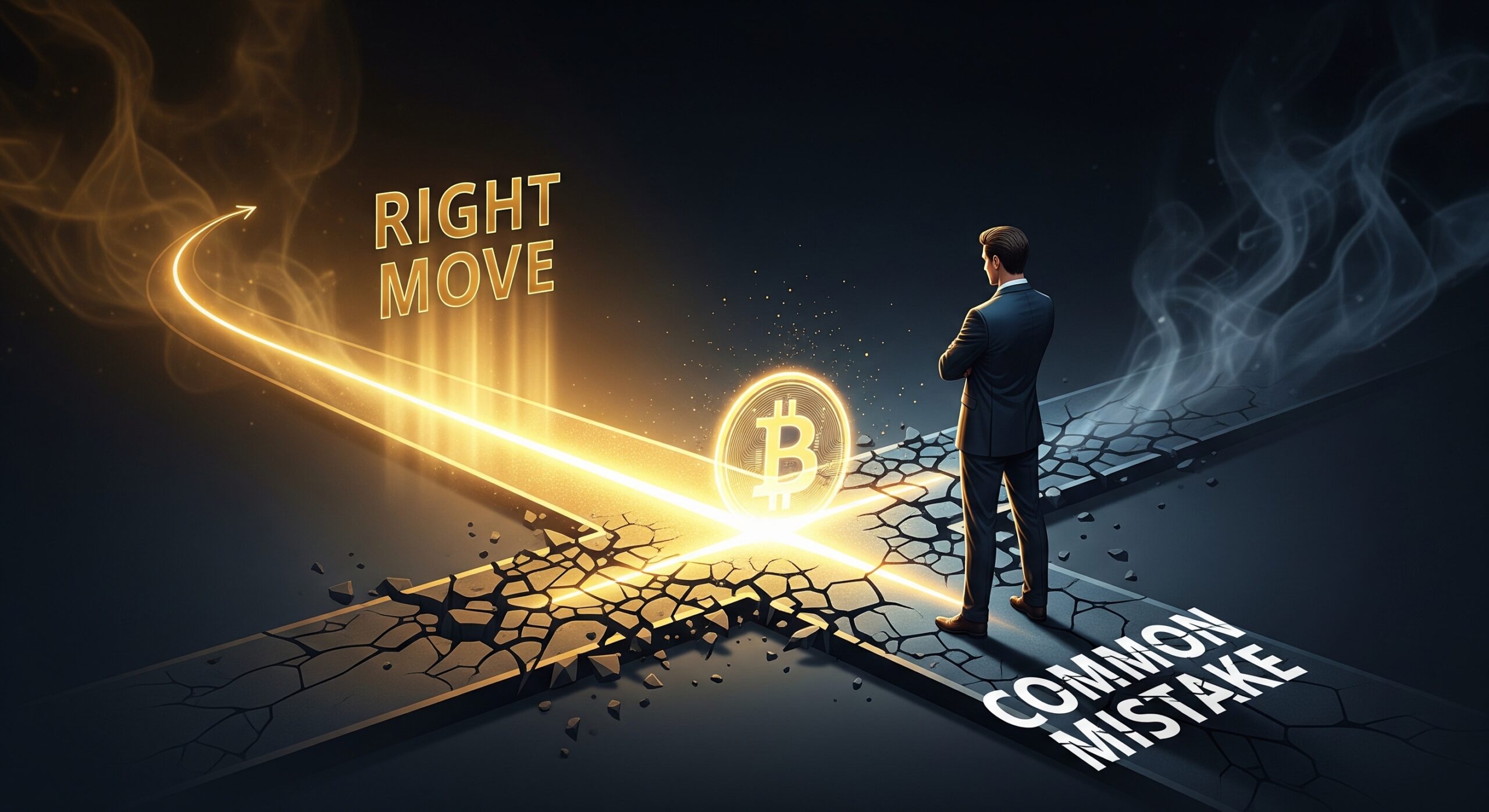
Three mistakes. That’s the difference between building real wealth with Bitcoin and spending the next 18 months watching a position bleed while wondering what went wrong. I’ve made all three. Not in theory — in real money, at real market prices, with real consequences. And the frustrating part is that none of them required bad luck. They required nothing more than the wrong decision at a critical moment. By the time you finish reading this, those moments won’t catch you the same way they caught me.
Why People Start Investing in Bitcoin
Nobody decides to invest in Bitcoin because life is going perfectly. They decide because something in their financial reality stopped being acceptable.
The salary that felt enough five years ago doesn’t cover the same life anymore. The savings account earning 0.5% interest while inflation runs at 4% is a documented, slow-motion loss. The housing market is priced out for an entire generation. And traditional investment vehicles — index funds, bonds, and pension plans — operate on a 30-year timeline that doesn’t feel urgent enough for the problem at hand.
⚡ Featured Web3 Resource
Verify smart contracts, track on-chain assets, and audit token security instantly using our recommended platform.
Access Verified Web3 Tool →Bitcoin showed up as a different answer. A fixed supply of 21 million coins — ever. No central bank prints more when the economy needs a shortcut. No government can freeze it or devalue it overnight. A 12-year track record of recovering from every crash and reaching new highs. Institutional adoption from companies like BlackRock, Fidelity, and MicroStrategy that don’t make multi-billion dollar bets on things they don’t believe in.
That combination — scarcity, decentralization, proven cycles, and now institutional credibility — is why investing in bitcoin became the conversation it is. Not hype. A genuine alternative for people who looked at their options and decided the traditional path wasn’t working fast enough.
Why You Should Seriously Consider It
Let me be direct about something most financial content won’t say out loud.
Is investing in Bitcoin a good idea? For most people who approach it with discipline, a realistic time horizon, and the right strategy — yes. Not because Bitcoin is guaranteed to go up. Nothing is. But because the asymmetric opportunity Bitcoin represents — where the downside is capped by your position size and the upside has delivered life-changing returns across multiple cycles — is genuinely rare in any asset class.
The people who lost money in Bitcoin didn’t lose it because Bitcoin failed them. They lost it because they made the three mistakes this article is built around. Remove those mistakes from your approach, and the story changes completely.
Before going further — if you want to understand where Bitcoin is likely heading in the current cycle, I broke down the key price levels in my Bitcoin Price Prediction 2026 analysis. That context will make everything in this article more actionable.
My Personal Case Study: Three Mistakes, Three Lessons
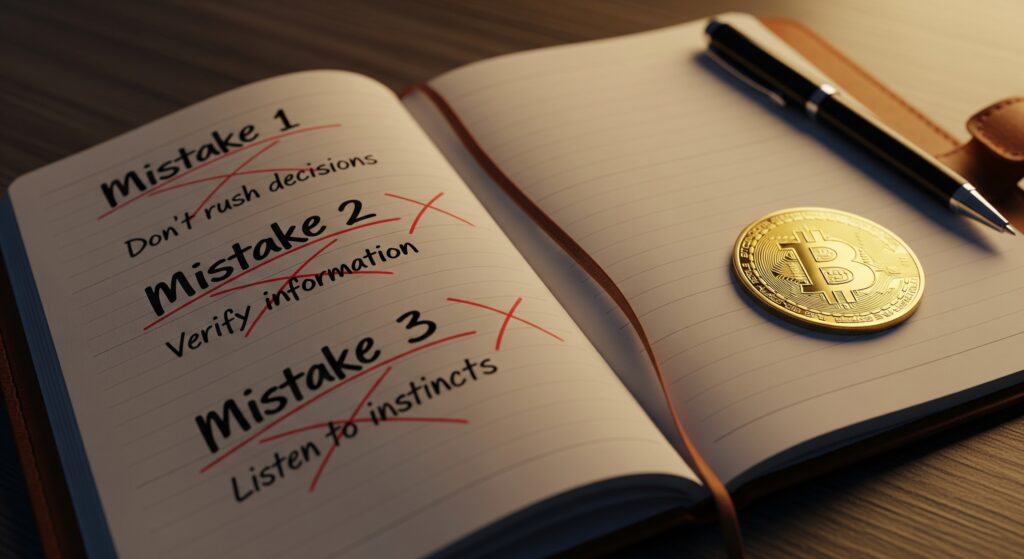
I want to give you the actual story—not the cleaned-up version.
The first time I invested in Bitcoin, I did it because everyone around me was talking about it. The price was climbing, the news was everywhere, and I felt the specific anxiety of missing something important. I bought a position at what turned out to be the tail end of a bull run. Within six weeks, the price had dropped 35%. I panicked and sold. Two months later, it recovered past my entry price. I paid tuition for a lesson I hadn’t signed up for.
The second mistake came later. I had a better entry. The position was green. But I had no plan for when to take profit — no price target, no percentage trigger, nothing. When the bull market peaked and started reversing, I kept holding, convinced every dip was temporary. By the time I accepted, it wasn’t temporary anymore; I’d given back most of the gain. The position I entered, well, I exited badly.
The third mistake is the one that still bothers me most. I left a meaningful amount of Bitcoin sitting on an exchange for months — not because I didn’t know better, but because moving it felt complicated. That exchange had a security incident. I wasn’t personally affected, but the people had lost everything they’d built. I moved everything to cold storage the same day. But I should have done it the same day I bought it.
Three different mistakes. Three different stages of the journey. All three are completely avoidable. All three are still happening to new Bitcoin investors right now.
Is It Worth Investing in Bitcoin Right Now?
Let me answer this honestly before we get into the mistakes — because if you’re reading this with fresh intent, you need a clear answer first.
Is it worth investing in Bitcoin in 2026? The macro case for Bitcoin in the current environment is as strong as it has ever been. The Bitcoin ETF approvals brought institutional money into the market at a scale that changed the liquidity and legitimacy picture permanently. The 2024 halving reduced the new Bitcoin supply entering the market. Sovereign wealth funds and national governments are actively discussing Bitcoin reserve strategies.
None of that guarantees price appreciation on any specific timeline. But it means the structural demand case — more buyers competing for a fixed and shrinking supply — is fundamentally intact.
Is it still worth investing in Bitcoin if you missed the previous cycle’s gains? Yes — and here’s why. Every person who asked that question at $5,000 and didn’t buy wishes they had. Every person who asked for it at $20,000 and didn’t buy it wishes they had. The question itself is usually asked at a moment when the price feels high. It almost always looks reasonable in hindsight.
Is it safe to invest in Bitcoin today? Bitcoin carries real risk — volatility, regulatory uncertainty, and market cycle timing. Anyone who tells you it’s completely safe is either uninformed or selling something. But “safe” and “worth it” are different questions. The risk is real and manageable. The opportunity, for a patient investor with the right approach, is also real.
How Does Investing in Bitcoin Work?
How does investing in Bitcoin work in the simplest possible terms?
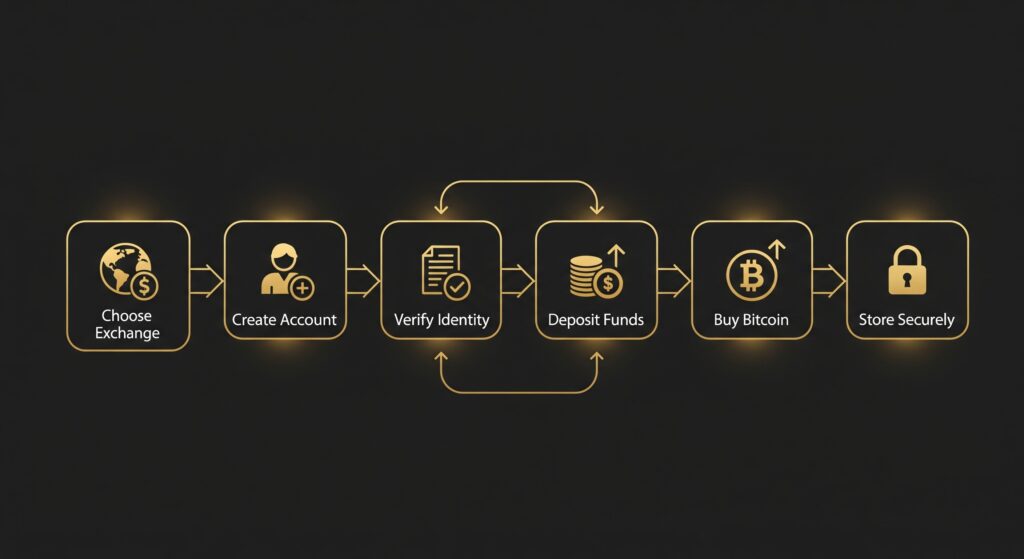
You open an account on a regulated cryptocurrency exchange, complete identity verification, deposit funds in your local currency, and purchase Bitcoin. Bitcoin is then held in your exchange wallet—or transferred to a personal hardware wallet for long-term security.
How to start investing in Bitcoin step by step:
Step 1 — Choose a regulated exchange. For most beginners, Coinbase is the starting point. It’s regulated, insured, beginner-friendly, and available in most countries. Binance and Kraken are strong alternatives with lower fees for larger amounts.
Step 2 — Complete KYC verification. Know Your Customer verification is a legal requirement on regulated exchanges. You’ll need a government-issued ID and proof of address. This takes 24–48 hours on most platforms.
Step 3 — Start with an amount you’re genuinely comfortable losing. Not because Bitcoin is likely to go to zero, but because starting with money that creates financial stress leads to emotional decisions. Start smaller than feels significant. Get comfortable with how the market moves before scaling up.
Step 4 — Buy Bitcoin — not a substitute. When you’re investing in Bitcoin for beginners, the single most important decision is buying actual Bitcoin — not a lookalike, not a derivative, not “Bitcoin Gold” or “Bitcoin SV.” Bitcoin (BTC) only. Every other asset has an entirely different risk profile, and most of them don’t share Bitcoin’s fundamentals.
Step 5 — Decide where to store it. This is where most beginners stop thinking — and where Mistake 3 lives. More on this shortly.
Investing in Bitcoin with Small Amounts — Does It Actually Work?
This is one of the most searched questions in crypto, and the answer surprises most people.
Investing 100 in Bitcoin today — is it worth it? Yes. Not because $100 will make you rich quickly. But because $100 invested consistently and repeatedly at a disciplined schedule builds a meaningful position over a full Bitcoin cycle. The entry amount matters far less than the consistency of the approach.
Investing 1000 in Bitcoin today gives you a more substantial position to work with. At current prices, $1,000 buys a fraction of a Bitcoin — but Bitcoin is infinitely divisible. You’re not buying whole coins. You’re buying a percentage of the network’s total value, and that percentage grows with the network.
Investing a dollar in bitcoin — yes, this is actually possible and legitimate. Fractional Bitcoin purchases are available on every major exchange. The minimum purchase on most platforms is $1–$2. This isn’t a joke entry point — for someone building a habit, starting with $1 and scaling up as confidence grows is a completely valid approach.
The dollar-cost averaging strategy covered in detail is exactly how small amounts become meaningful positions over time. Fixed amount, consistent schedule, regardless of price — that’s the framework that turns $100/week into a serious Bitcoin position across a full market cycle.
Investing in Bitcoin ETF — What It Means for You

Investing in a Bitcoin ETF became a mainstream option after the SEC approved spot Bitcoin ETFs in early 2024. This changed the investment landscape in a specific way that matters for you.
A Bitcoin ETF lets you gain exposure to Bitcoin’s price movement through a traditional brokerage account — the same account you might use for stocks. You don’t need a crypto exchange, you don’t need to manage private keys, and the investment sits within your existing regulated financial infrastructure.
Who the Bitcoin ETF is best for:
- Investors who want Bitcoin exposure without managing crypto wallets
- People whose investment accounts are through traditional brokerages
- Pension and retirement account holders who can’t hold crypto directly
- Investors in jurisdictions where a direct Bitcoin purchase is complicated
Who should buy actual Bitcoin instead:
- Anyone who wants true ownership — an ETF holds Bitcoin on your behalf
- Long-term holders who want self-custody control
- People who want to use Bitcoin as a currency or transfer it freely
Investing in Bitcoin in the UK or in Australia — both regions have access to Bitcoin ETFs and regulated exchanges. UK investors commonly use platforms like Coinbase UK or Kraken. Australian investors use Swyftx, CoinSpot, or international platforms with Australian regulatory compliance. Always verify the regulatory status of any exchange in your specific jurisdiction before depositing funds.
What Are the Risks Associated With Investing in Bitcoin?
Honest answer — and this is the part I don’t sugarcoat.
Volatility risk: Bitcoin regularly moves 30–70% in either direction within a single market cycle. A position that’s up 60% can give back half of that in weeks. If you can’t mentally and financially handle that range of movement, the position size is too large for your situation.
Timing risk: Buying at a cycle peak and needing to sell before recovery is the most common way people lose real money in Bitcoin. This is the risk that the bear-and-bull market cycle awareness directly addresses.
Security risk: Bitcoin held on exchanges is subject to that exchange’s security. Exchanges have been hacked, gone insolvent, and shut down by regulators. Bitcoin in your own hardware wallet is subject only to your own security practices.
Regulatory risk: Governments are still determining how to classify and regulate Bitcoin. Regulatory changes can affect price, access, and tax treatment. This risk exists but has decreased significantly as institutional adoption has normalized Bitcoin as an asset class.
Emotional risk: This is the one nobody lists, but it’s the one that costs the most money. The crypto fear and greed index measures this risk in real time. When extreme greed is driving the market, retail investors buy things they wouldn’t buy calmly. When extreme fear is running, they sell things they should be holding. Emotional risk is the multiplier that makes every other risk worse.
Is Investing in Bitcoin Safe for the Long Term?
Is it safe to invest in Bitcoin today for long-term holders? The historical case is compelling. Every investor who held Bitcoin for any continuous 4-year period since 2013 ended in profit. That’s not a guarantee of future performance — but it’s the strongest long-term track record of any asset in that timeframe.
Is it safe to invest in Bitcoin today for beginners? Safe enough — with three conditions:
- You invest an amount you won’t need to access under financial pressure
- You use a regulated exchange and understand basic security
- You don’t make the three mistakes this article exists to prevent
The risk in Bitcoin investing isn’t in Bitcoin itself. It’s in the decisions people make around it.
Now — The 3 Mistakes
I’ve been building toward these because they need context to land properly. If I’d listed them at the start, they’d read like generic advice. Now you know why each one matters — because you’ve seen the full picture of what investing in Bitcoin actually involves.
Mistake 1 — Buying Because the Market Is Loud

This is the mistake I made first, and it’s the one that gets the most people.
When Bitcoin is making headlines, when your colleagues are talking about it at lunch, when every YouTube thumbnail is showing green candles and big percentage gains — that’s the moment most beginners buy. It feels like the right time because everything around you is confirming it. It is almost always the wrong time.
The crypto fear and greed index sits at Extreme Greed during these moments — meaning the market is at maximum emotional temperature. The people who built positions during the quiet months of fear and uncertainty are now selling into the excitement you’re bringing in with your buy. You’re not joining a trend. You’re providing the exit for people who got in before the noise started.
This is the FOMO trap, and it’s not a character flaw. It’s a neurological response to social pressure and the fear of missing out on something everyone else seems to be getting. The bear and bull market traps are specifically engineered to trigger this response at the exact moment that benefits someone else.
How to avoid it:
Stop asking, “Is it worth investing in Bitcoin now?” when the market is loud. Start asking about it when the market is quiet — when Bitcoin is down 40%, when the headlines have gone negative, when your colleagues have stopped mentioning it. That silence is usually where the real entry points live.
Check the fear and greed index before any Bitcoin purchase. If it’s above 75, reduce your planned purchase size. If it’s below 30, consider increasing it. Let the crowd’s emotional temperature guide your position size — inverse to how they’re behaving.
Mistake 2 — Investing Without an Exit Plan

This one is quieter than the first mistake. It doesn’t feel like a mistake when you’re making it — it feels like patience. You buy Bitcoin. The price goes up. You feel smart. You hold because it keeps going up, and selling feels premature. Then the market peaks and starts reversing. You hold because every dip looks like a buying opportunity. Then the reversal becomes a trend. You hold because selling now means admitting it went wrong. Then you’re back below your entry price, holding an asset you’re no longer confident in, with no plan for what happens next.
I’ve lived every stage of that sequence. The problem was never Bitcoin. The problem was that I had a detailed entry plan and an empty exit plan.
What are the risks associated with investing in Bitcoin without an exit plan? You’re flying without landing gear. The takeoff works fine — it’s the coming down that destroys things.
How to build your exit plan before you invest:
Set your profit targets before you buy — not after you’re sitting on gains and feeling invincible. Here’s the framework I use now:
- Take 20–25% of the position off when you’re up 2x from your entry
- Take another 25% when you’re up 3–4x
- Reassess the remaining 50% using on-chain data and the market cap dominance picture when the broader market shows distribution signals
- Never sell everything at once — staged exits protect against selling into a temporary dip that recovers immediately after
The Bitcoin Price Prediction 2026 key levels I mapped out are the reference points I use for these targets. Specific price levels give you objective exit triggers that aren’t influenced by how you feel on any given day.
Mistake 3 — Leaving Bitcoin on an Exchange
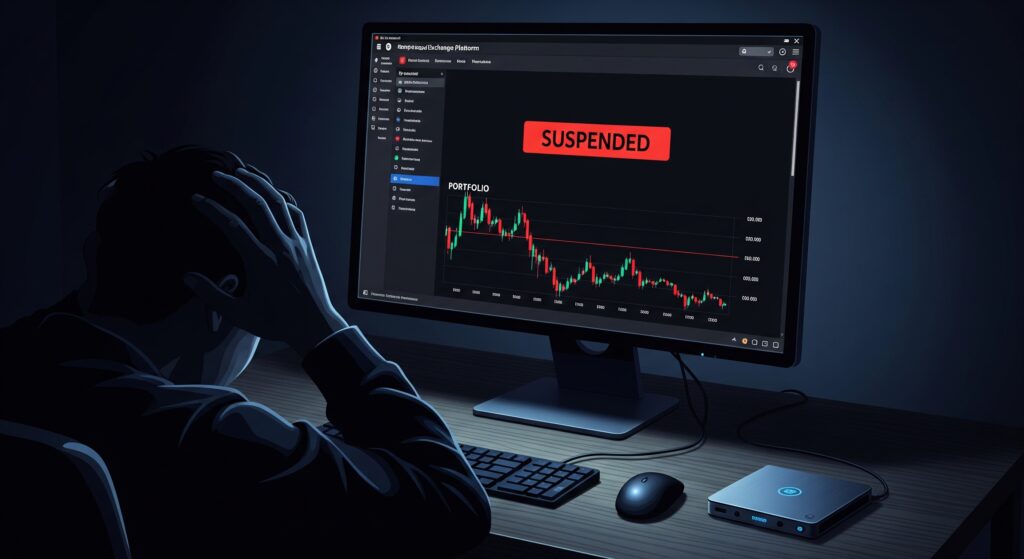
This is the mistake most beginners make indefinitely, not just once. And it’s the one with potentially catastrophic consequences.
When you buy Bitcoin on an exchange and leave it there, you don’t actually own Bitcoin in the fullest sense. You own a claim on Bitcoin. The exchange holds the actual asset. If that exchange gets hacked, goes insolvent, faces a regulatory shutdown, or simply makes a business decision to freeze withdrawals, your claim becomes very difficult to collect on.
This is not a theoretical risk. FTX collapsed in 2022, and customers lost billions in assets that were supposed to be safely held. Mt. Gox lost 850,000 Bitcoin in a hack that took years of legal proceedings to partially address. Celsius Network froze withdrawals before declaring bankruptcy. In every case, the investors who lost the most were the ones who left their Bitcoin on the platform rather than withdrawing to self-custody.
The rule in crypto has a name: “Not your keys, not your coins.”
If you don’t hold the private keys to your Bitcoin wallet, you don’t fully own the Bitcoin. You own whatever promise the exchange is making to you today.
How to fix this — investing in Bitcoin safely:
For amounts you’re actively trading, keeping Bitcoin on a reputable, regulated exchange is acceptable. Use an exchange with a strong security track record and enable all available security features — 2FA, withdrawal whitelists, and login notifications.
For amounts you’re holding long-term: move to a hardware wallet within 30 days of purchase. Ledger and Trezor are the two most established hardware wallet manufacturers. Your Bitcoin lives on the blockchain — the hardware wallet just stores the private key that controls it. Even if the device breaks, your Bitcoin is recoverable with a seed phrase backup stored securely offline.
What are the risks associated with investing in Bitcoin in self-custody? Human error — losing your seed phrase, entering it on a phishing site, or storing it somewhere that gets destroyed. These risks are real but manageable with basic precautions. They’re significantly less catastrophic than exchange risk at scale.
The rule is simple: buy on an exchange and store in your wallet. Every long-term Bitcoin investor learns this eventually. The ones who learn it before losing money to an exchange failure learned it the easy way.
The Killer Strategy: How to Start Investing in Bitcoin Right
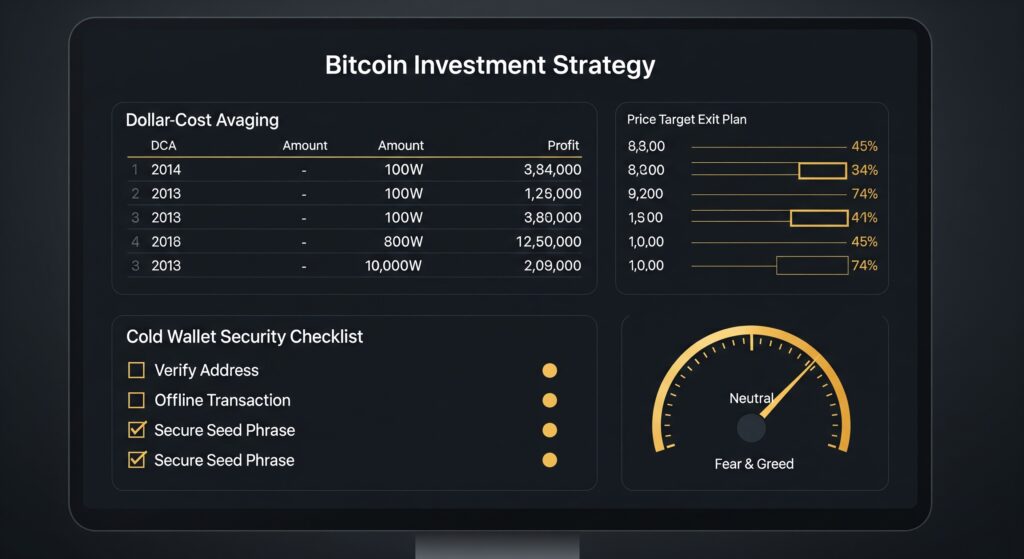
Here’s the complete framework for investing in Bitcoin for beginners that eliminates all three mistakes from the start:
The Entry — Sentiment-Driven, Not Noise-Driven
Check the Crypto Fear and Greed Index before every purchase. Use it as your position size guide:
- Index below 30 (Fear): buy your planned full amount
- Index 30–60 (Neutral): buy 75% of the planned amount
- Index 60–80 (Greed): buy 50% of the planned amount
- Index above 80 (Extreme Greed): buy 25% or wait
This single filter would have saved me from Mistake 1 completely.
The Schedule — Consistent and Automated
Set up a weekly automated buy regardless of price. The dollar-cost averaging framework handles the entry timing risk automatically. Combined with the sentiment filter above, you have both a systematic schedule and a size adjustment mechanism working together.
Investing in Bitcoin now with a weekly DCA schedule means you never have to make a high-pressure timing decision again. The system makes it for you.
The Exit — Written Before You Buy
Before your first purchase, write down:
- The price level at which you take the first profit (20–25% of the position)
- The price level at which you take the second profit
- The market condition that would trigger a full reassessment
- The one scenario in which you sell everything (hint: it should be a fundamental change in Bitcoin’s security or adoption case — not a 30% price drop)
Write this. Save it. Look at it every time you feel the urge to deviate.
The Storage — Hardware Wallet Within 30 Days
Buy a Ledger or Trezor hardware wallet. Move your long-term holdings off the exchange within 30 days of purchase. Store your seed phrase in two physically separate secure locations — not on your phone, not in a cloud service, and not in a photo on your camera roll.
This takes two hours to set up once and protects your position for as long as you hold.
How Much Should You Invest in Bitcoin?
Investing 100 in Bitcoin today is legitimate. Investing 1000 in Bitcoin today builds a more meaningful position. The right number is whatever meets three criteria simultaneously:
- You won’t need it for at least 12–24 months
- You won’t make an emotional decision if it drops 40% temporarily
- Losing it entirely wouldn’t damage your financial life
That intersection is your correct position size. Not a percentage someone on the internet recommended. The number that genuinely fits your situation.
FAQ: Investing in Bitcoin — Every Question Answered
Q: Is investing in Bitcoin a good idea for beginners?
Yes — with the right approach. Bitcoin has the strongest long-term track record of any crypto asset, the deepest liquidity, and the most institutional backing. For beginners, starting with a small weekly DCA into Bitcoin through a regulated exchange is the lowest-risk entry into crypto investing.
Q: Is it safe to invest in Bitcoin today?
Bitcoin carries real volatility and security risks — but both are manageable. The volatility risk is managed by position sizing and a DCA schedule. The security risk is managed by using regulated exchanges and moving long-term holdings to hardware wallet self-custody.
Q: How much should I start with when investing in Bitcoin?
Start with an amount you’re genuinely comfortable with — not comfortable losing in theory, but comfortable watching drop 40% on a Tuesday morning without making a panic decision. For most beginners, that’s $50–$200/week on a DCA schedule. Grow the amount as your confidence and understanding grow.
Q: Is it worth investing in Bitcoin in 2026?
The macro case in 2026 includes post-halving supply reduction, institutional ETF adoption, and growing sovereign interest in Bitcoin as a reserve asset. The structural demand-versus-supply picture supports the long-term case. Whether the timing is right for a lump sum depends on where we are in the cycle — a DCA approach removes the timing question entirely.
Q: What are the risks associated with investing in Bitcoin?
The main risks are: price volatility, exchange security, regulatory changes, and emotional decision-making. All four are real. All four are manageable with the right framework — position sizing, self-custody, regulatory awareness, and a pre-written exit plan.
Q: Is it safe to invest in Bitcoin today for the long term?
For patient investors with a 3–5 year horizon, the historical risk profile is strongly favorable. Every 4-year holding period in Bitcoin since 2013 has ended in profit. Long-term investing in Bitcoin with self-custody and no forced selling pressure is the most documented path to positive returns in the asset.
Q: How does investing in Bitcoin work for complete beginners?
Choose a regulated exchange, verify your identity, deposit funds, buy Bitcoin, and transfer long-term holdings to a hardware wallet. The actual mechanics take one afternoon to set up. The strategy — DCA schedule, sentiment-adjusted sizing, and written exit plan — takes one more afternoon to define. After that, the system runs itself.
Q: What is investing in a Bitcoin ETF, and is it better than buying directly?
A Bitcoin ETF gives you price exposure through a traditional brokerage without managing crypto wallets. It’s better for investors who want Bitcoin in their existing financial accounts. Buying Bitcoin directly gives you true ownership and self-custody control. For long-term holders who want full control, direct ownership is preferable. For investors whose financial infrastructure is traditional-brokerage-based, ETFs are a practical alternative.
Q: Is investing in Bitcoin now a good decision?
The right time to start is when you have a clear strategy — not when the price feels right. A weekly DCA schedule makes “when to start” largely irrelevant because you’re averaging across whatever price range plays out. Start now with a small amount, build the habit, scale as your understanding deepens.
Q: How to invest in Bitcoin in the UK or Australia?
UK investors can use Coinbase UK, Kraken, or Binance with local regulatory compliance. Australian investors commonly use Swyftx, CoinSpot, or Coinbase’s Australian service. Always verify the current regulatory status in your specific region before depositing. Both markets have clear legal frameworks for Bitcoin investment and active regulated platforms.
Q: What is the minimum amount for investing in Bitcoin?
Most major exchanges allow Bitcoin purchases from as little as $1–$2. You don’t need to buy a whole Bitcoin — you buy a fraction. Fractional ownership means the minimum is essentially whatever the exchange sets as its floor, which is accessible to almost any budget.
Q: How do I avoid the biggest mistakes when investing in Bitcoin?
Three rules: Don’t buy because the market is loud and everyone is excited — check sentiment first. Write your exit plan before you buy — not after you’re holding gains. Move long-term holdings off exchanges into hardware wallet self-custody within 30 days of purchase. Those three rules eliminate the most common and most costly Bitcoin investment mistakes.
Final Thought
Bitcoin doesn’t care whether you make money or not. The market doesn’t know your name, doesn’t know your situation, and has no interest in whether your investment works out. What it does reward — consistently, across every cycle — is the investor who showed up with a plan, stayed patient through the noise, and protected their position with the right tools.
The three mistakes in this article aren’t rare. They’re the default path for most beginners — because nobody gave them the roadmap before they needed it. You have the roadmap now.
The market will test every part of your strategy. Make sure your strategy is worth building before it is.

Ammar Malik is an independent digital asset researcher and the founder of AmmarMagazine. He specializes in analyzing on-chain security and evaluating technical tools. Through clear, objective crypto resources, Ammar Malik delivers accessible Web3 education to help everyday users navigate the market safely.