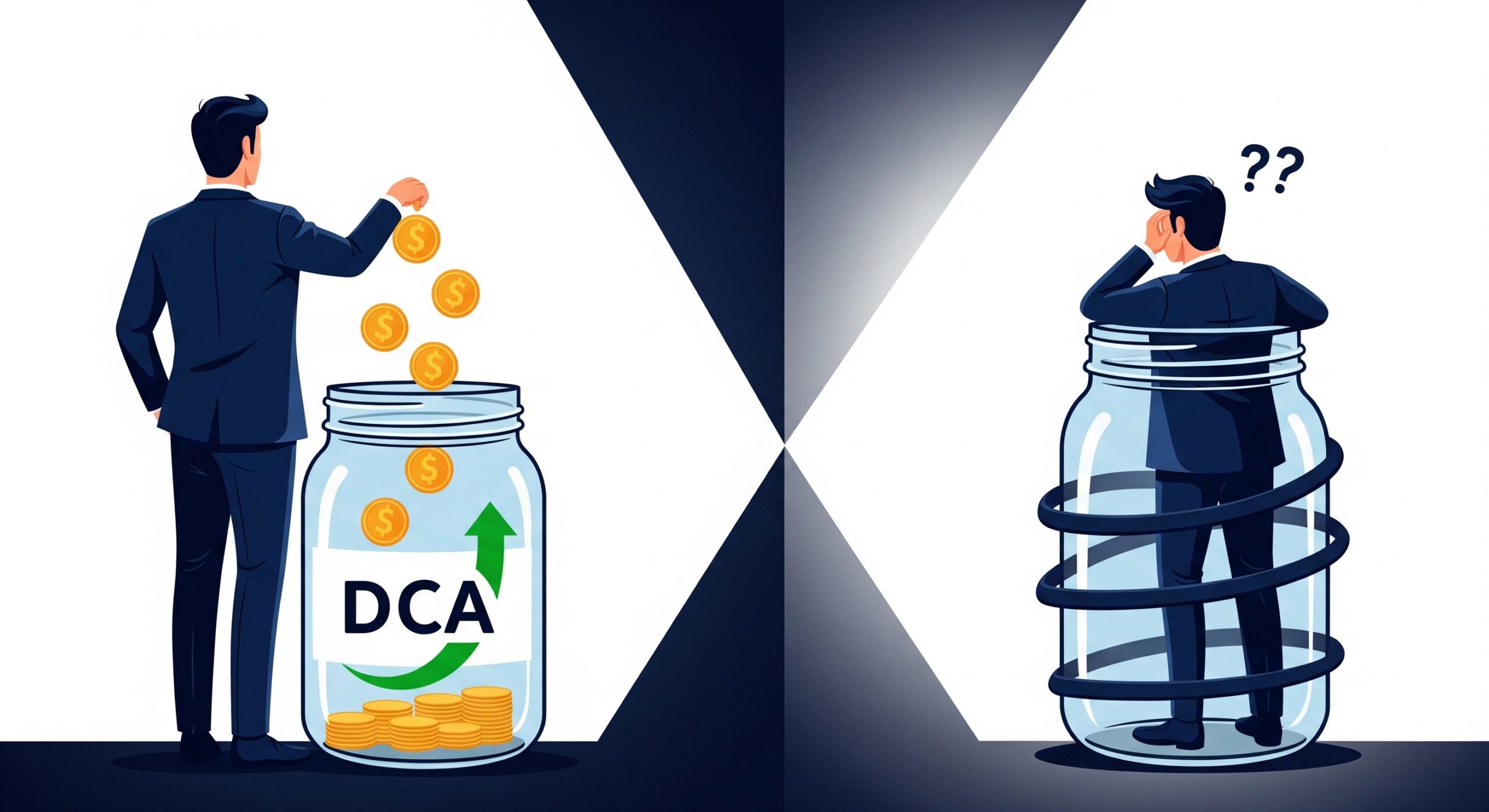
DCA looks safe. And when you use it on the right asset, with the right amount, and a defined exit plan — it genuinely is. But most beginners treat dollar cost averaging like a blanket shield against every mistake. They DCA into dying projects. They buy on schedule through bear markets that never recover for that specific coin. They keep the schedule running while ignoring every warning sign around them. The strategy isn’t broken. The misuse of it is. And by the end of this, you’ll know exactly which side of that line you’re standing on.
Why People Come to Crypto in the First Place
Nobody enters a volatile market because they enjoy stress. People come to crypto because something in their current financial life quietly stopped working. The salary that used to feel sufficient stopped keeping up with inflation. The savings account became a joke. The stock market started feeling like a game designed for people with Bloomberg terminals.
Crypto offered something real — a market where a regular person with a phone and $200 could make moves that traditional finance reserved for people with brokers and minimum balances. That openness is genuine. The opportunity is real.
⚡ Featured Web3 Resource
Verify smart contracts, track on-chain assets, and audit token security instantly using our recommended platform.
Access Verified Web3 Tool →But that same openness means the market has no gatekeepers. No one checks whether the coin you’re buying has real utility or is a well-packaged exit for someone who got in six months before you. Nobody warns you about that part in the YouTube thumbnails. And that’s exactly where dollar cost averaging investing enters as the recommendation — because it sounds disciplined, sounds safe, and sounds like the responsible thing to do.
Sometimes it is. Sometimes it accelerates the loss.
Why You Still Need to Be in This Market
The answer to a bad experience in crypto is never to leave. It’s to understand the rules of the game better than the person sitting across from you in the trade.
Crypto is one of the few markets where a retail investor with patience, basic knowledge, and emotional discipline can consistently outperform professionals over a full bear and bull market cycle.The tools are free. The data is public. The cycles are documented and repeatable.
What separates the people who build wealth here from those who lose it isn’t intelligence or connections. It’s whether they showed up with a system or with emotion. Dollar cost averaging crypto is one of the most powerful systems available to a beginner — but only when it’s built correctly from the start.
My Personal Case Study: The Same Strategy, Two Completely Different Outcomes
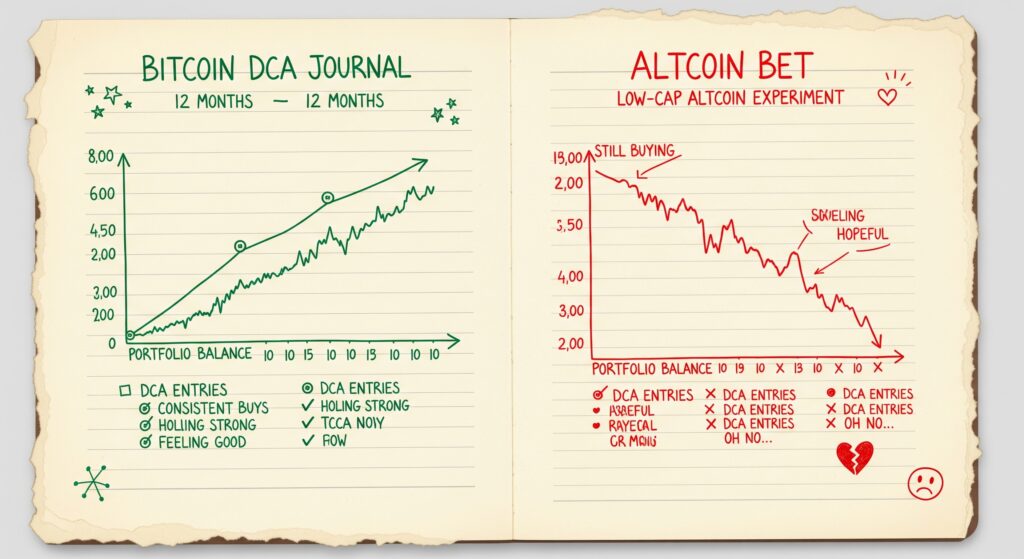
Two stories. Both mine. Both happened during the same bear market.
Story One — When DCA Worked
During the 2022 crypto bear market, when Bitcoin fell from $69,000 to under $17,000, I set up a fixed weekly buy. Not a large amount — small, consistent, automated. I didn’t check the price daily. I didn’t pause when it dropped further. I just maintained the schedule. When the market turned in 2023 and Bitcoin began its recovery, my average cost basis sat comfortably below $24,000. That position became one of the best returns I recorded that year — not because I timed anything correctly, but because I specifically stopped trying to.
Story Two — When DCA Made It Worse
Same period. Different project. Strong Telegram community, a polished whitepaper, and enough social media noise to feel legitimate. I applied identical DCA logic — fixed amount, weekly schedule. But the coin’s fundamentals were hollow. Trading volume was thin. The development team was anonymous. And instead of recovering with the broader market, that project bled to near zero across 18 months. I bought more units at every dip, lowering my average cost repeatedly — and still ended up sitting on a near-total loss because the asset itself had no reason to recover.
Same strategy. Same discipline. Two completely different outcomes.
The variable wasn’t DCA. It was the asset I chose to apply it to. That single lesson is worth more than everything else in this article.
What Is Dollar Cost Averaging? The Real Definition
Dollar cost averaging, meaning in plain language, you invest a fixed amount of money into an asset at regular, scheduled intervals — weekly, biweekly, or monthly — regardless of what the price is doing at that moment.
What is dollar cost averaging in investing? It’s the deliberate choice to stop timing the market and replace that gamble with a system. When prices are low, your fixed amount buys more units. When prices are high, it buys less. Over time, your average cost per unit lands somewhere between the market’s highs and lows — not at the worst point, not at the best, but consistently in the middle of whatever range played out.
What is dollar-cost averaging in stocks vs. crypto? In stocks, the principle is identical — but crypto’s extreme volatility makes the benefit more pronounced. A stock might swing 5–10% in a week. Bitcoin regularly moves 10–20% in the same window. That volatility is exactly what DCA turns from a threat into an advantage.
What does dollar cost averaging mean for your psychology? It means you make the investment decision once — when you’re calm, when you’ve done your research, when you’ve set your amount — and then the system executes it regardless of what the news cycle, the Twitter narrative, or your gut is telling you on any given Wednesday morning.
The Dollar Cost Averaging Formula (And How to Calculate It)
The dollar cost averaging formula is the simplest math in investing:
Average Cost Per Unit = Total Amount Invested ÷ Total Units Purchased
How to calculate DCA crypto in practice — track every buy, add up your total invested, add up your total units held, and divide. That number is your average cost basis. Compare it to the current price, and you know instantly whether you’re in profit or not — regardless of what the current price looks like on any single day.
Dollar-cost averaging crypto calculator — you don’t need a special tool for this. A basic spreadsheet with three columns (date, amount invested, and units purchased) and one formula gives you everything. But if you prefer an automated view, platforms like CoinGecko let you track your average cost basis across holdings in real time.
Average cost basis crypto explained simply: It’s the number that tells you whether the market owes you money or you owe the market patience.
Dollar Cost Averaging Example — Real Numbers, Real Clarity
Let’s make how dollar-cost averaging works completely concrete with a real scenario.
You decide to invest $200 per month into Bitcoin starting in January:
| Month | BTC Price | Amount Invested | BTC Purchased |
|---|---|---|---|
| January | $95,000 | $200 | 0.00211 BTC |
| February | $78,000 | $200 | 0.00256 BTC |
| March | $65,000 | $200 | 0.00308 BTC |
| April | $82,000 | $200 | 0.00244 BTC |
| May | $91,000 | $200 | 0.00220 BTC |
| Total | — | $1,000 | 0.01239 BTC |
Average cost = $1,000 ÷ 0.01239 = ~$80,710 per BTC
If you had invested the full $1,000 as a lump sum in January at $95,000, your cost basis would be $95,000. DCA brought it down to $80,710 without you making a single market timing decision.
That $14,290 difference in cost basis is the mechanical advantage of dollar cost averaging investing — and it happened automatically, without charts, without predictions, without stress.
Benefits of Dollar Cost Averaging — What They Always Tell You
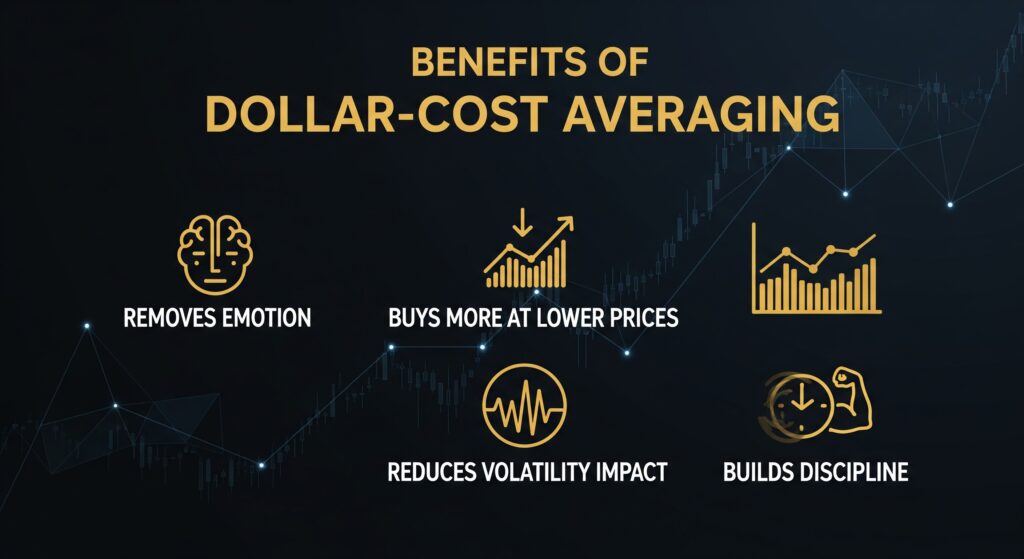
These are real. I’m not dismissing them. They exist, and they work — when the conditions are right.
It Removes Emotional Decision-Making
The crypto fear and greed index shows that retail investors as a group consistently buy when greed peaks and sell when fear bottoms. DCA removes you from that cycle entirely. You don’t buy more because you’re excited. You don’t stop because you’re scared. The schedule decides — not your mood on any given morning.
It Naturally Buys More When Prices Are Low
When the market crashes, most retail investors freeze or sell. DCA keeps buying — automatically accumulating more units at lower prices. It mechanically executes the “buy the dip” advice that everyone gives, and almost nobody actually follows consistently.
It Reduces the Impact of Volatility
A lump sum entry locks you into one price point and makes you a hostage to timing. DCA spreads that entry risk across months or years. A single bad week doesn’t define your position.
It Builds Real Financial Discipline
The act of investing consistently — regardless of the news cycle or the price action — builds the kind of long-term discipline that compounds. Not just in returns. In the habits and mindset that make every financial decision after this one better.
How Can You Benefit From Dollar Cost Averaging as an Investor?
The benefit that nobody mentions: DCA lowers the emotional cost of investing. The anxiety of wondering if you bought at the wrong time? Gone. The regret of watching a price drop after a lump sum entry? Significantly reduced. Dollar cost averaging gives you a framework to participate in one of the most volatile markets on earth without it consuming your mental energy.
Dollar Cost Averaging vs Lump Sum — Which One Actually Wins?
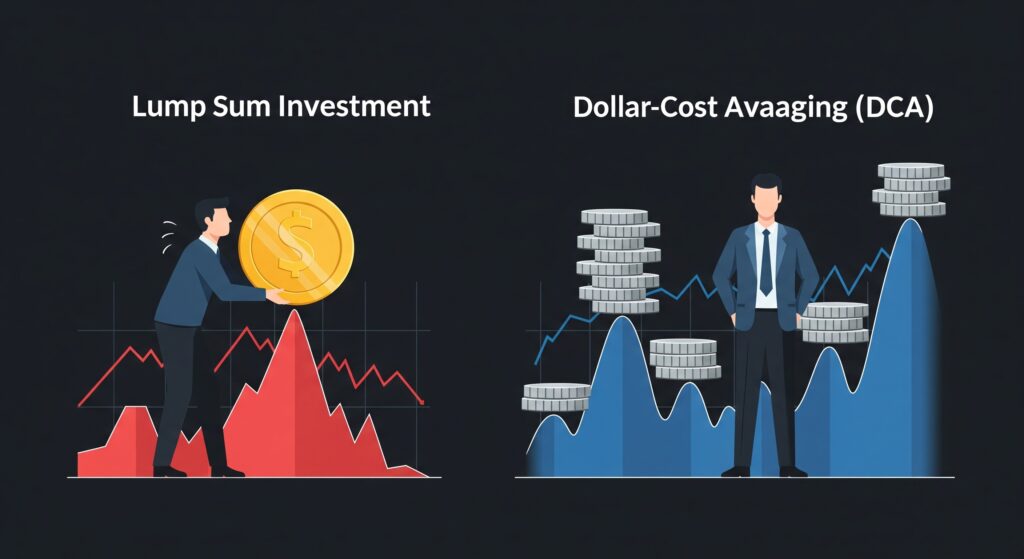
Lump sum investing vs dollar cost averaging — this is the question every serious investor eventually faces. Here’s the honest answer backed by data:
In traditional equity markets, lump-sum investing outperforms DCA roughly two-thirds of the time. The reason is simple: markets trend upward over time, and getting money in earlier captures more of that upward movement.
In crypto, the calculation shifts significantly — and here’s why:
Bitcoin regularly swings 70–80% from peak to trough in a bear market. A lump sum entry at the wrong moment doesn’t just underperform — it takes 2–3 years to recover. DCA removes that catastrophic single-entry risk entirely.
When a lump sum beats DCA in crypto:
- You invest at or near a documented cycle bottom
- You’re buying Bitcoin or Ethereum at a proven macro support level
- You have a time horizon of 3+ years and the emotional discipline to hold through a 60% drawdown without selling
When DCA beats lump sum in crypto:
- You’re a beginner without the experience to identify cycle lows
- You’re investing during uncertain macro conditions with no clear entry signal
- You want to reduce emotional pressure and build a position over time
- You’re investing an amount that represents real money to you — money you’d feel if it dropped 40% overnight
Is dollar cost averaging the best way to invest for most beginners? Yes. Not because the math is always superior — but because it’s the strategy most people can actually execute without panic. A theoretically perfect lump sum strategy that gets abandoned at the first 30% drop beats nothing. A consistent DCA strategy that runs through the full cycle beats almost everything.
Dollar Cost Averaging Bitcoin Strategy — Why Bitcoin Specifically
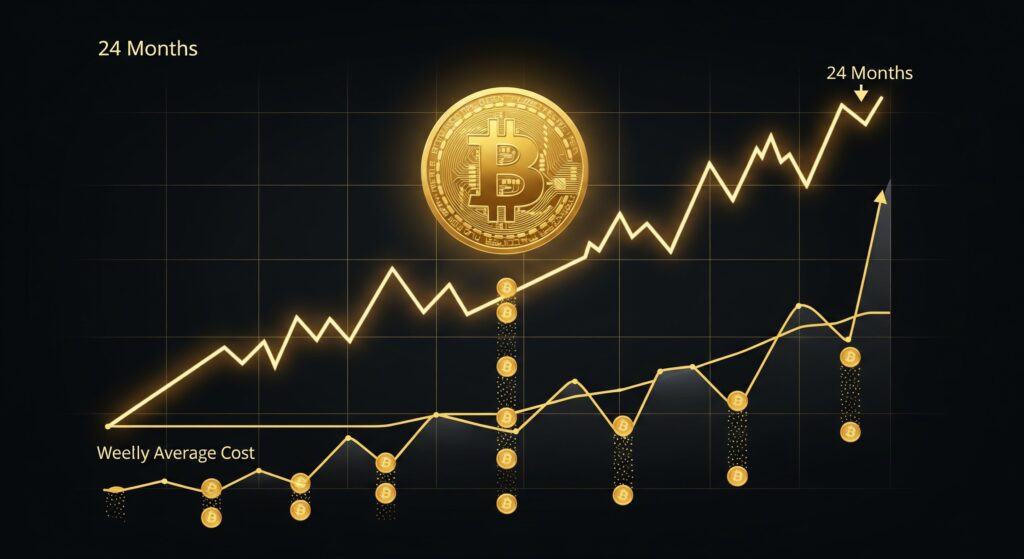
If you DCA one asset and one asset only — make it Bitcoin. This isn’t a preference. It’s what historical data consistently supports.
Dollar cost averaging Bitcoin results across multiple cycles:
- A $10/week Bitcoin DCA from 2019 through 2024 turned $2,610 into roughly $7,900—over a 200% return without a single timing decision
- Every rolling 3-year DCA window into Bitcoin since 2013 has ended in profit — including windows that started at cycle tops
- An investor who DCA’d through the FTX collapse, the 2023 uncertainty, and the 2024–2025 volatility would be sitting on strong returns simply by staying consistent
Why the dollar cost-averaging Bitcoin weekly strategy specifically works:
Bitcoin’s fixed supply of 21 million coins means every scheduled buy is competing against a permanently shrinking available supply. As institutional adoption grows — ETFs, corporate treasury allocations, sovereign wealth fund interest — the demand side of that equation increases while the supply side stays fixed. DCA into that dynamically and consistently, and time does the heavy lifting.
Dollar cost averaging Bitcoin weekly vs. monthly: Weekly beats monthly in high-volatility environments because you catch more price variation points. More data points = smoother average cost. A weekly $50 investment gives you 52 entry points per year. A monthly $200 investment gives you 12. The weekly schedule wins statistically in a volatile market.
Dollar Cost Averaging Ethereum Strategy
Ethereum deserves its own mention. The dollar-cost-averaging Ethereum case is slightly different from Bitcoin but equally compelling:
- Ethereum’s deflationary mechanics (EIP-1559 fee burning) reduce supply during high network activity periods
- Staking rewards mean DCA investors can earn approximately 3–4% annually on their accumulated position while they wait
- The developer ecosystem and real-world utility applications give Ethereum fundamental support that most altcoins can never match
Best crypto to dollar cost average into in order of risk-adjusted merit:
- Bitcoin — lowest risk, most proven, deepest liquidity, strongest institutional adoption
- Ethereum — second-tier risk, real utility, staking bonus on top of price appreciation potential
- Everything else — significantly higher risk, requires individual research before any DCA commitment
DCA Crypto: Daily vs. Weekly vs. Monthly — Which Frequency Works Best?
This question has a real answer, and most articles dodge it.
DCA crypto daily: Mathematically captures the most price variation, but transaction fees on daily buys can eat into smaller investment amounts. Only worth it if your exchange offers zero-fee recurring buys or your investment amount is large enough that fees are negligible.
DCA crypto weekly: The sweet spot for most investors. Enough frequency to smooth volatility meaningfully, manageable from a fee perspective, and psychologically easy to maintain. A weekly schedule running for 12–24 months gives you 52–104 entry points — enough to average out even the most brutal market swings.
DCA crypto monthly: Suitable for larger investment amounts where the math still works despite fewer entry points. For amounts under $500/month, weekly is more efficient because you get 4x the price variation coverage.
How long should you DCA into Bitcoin? The minimum effective window is 12 months. The optimal window for capturing a full cycle’s advantage is 24–36 months. Anyone who started a weekly Bitcoin DCA at any point in 2022 and held through to 2024 ended in profit regardless of their specific entry month. Time in the strategy beats timing the strategy every single time.
Best DCA frequency crypto recommendation: Weekly, automated, on a Tuesday or Wednesday. Research shows mid-week buys historically capture slightly lower average prices than weekend buys due to lower institutional trading activity — a small edge that compounds over the years.
Is Dollar Cost Averaging a Good Strategy for Crypto? The Honest Answer
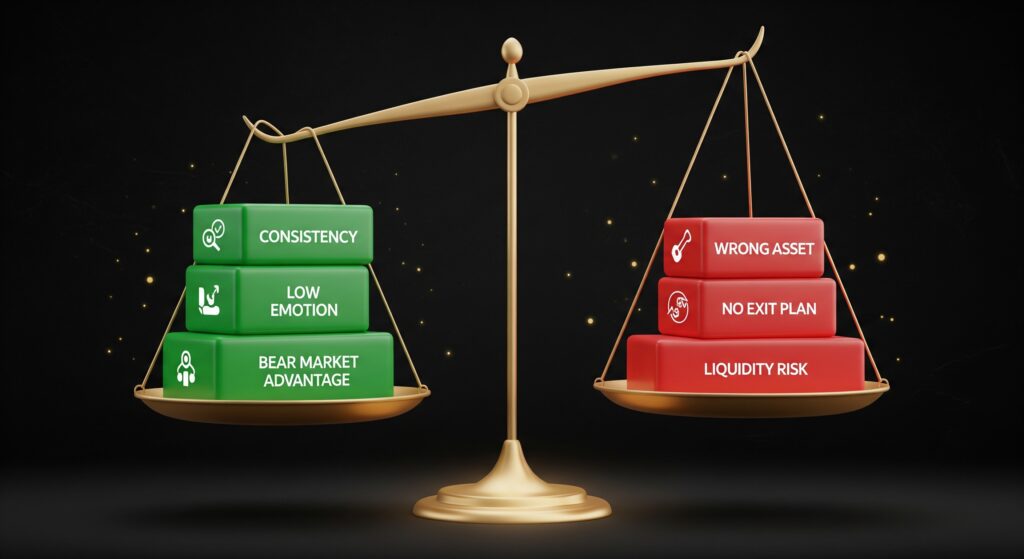
Is dollar cost averaging a good strategy? Yes — conditionally. And the conditions matter more than the strategy itself.
DCA works when:
- You’re buying an asset with proven long-term demand and fundamental value
- Your investment amount is consistent and committed — money you won’t need for 12–24 months
- You have a defined exit or profit-taking plan before you start
- Your position size relative to the coin’s daily liquidity is manageable (covered in my crypto liquidity guide)
- You maintain the schedule through bear markets — especially through bear markets
DCA fails when:
- The asset you’re buying has no genuine utility, user base, or survival probability
- You stop buying when prices drop, which defeats the entire mathematical advantage
- You invest money with a time pressure attached to it
- You have no exit plan and just accumulate indefinitely with no profit-taking trigger
Is dollar cost averaging good in a bear market? This is where DCA earns its reputation. The bear market is the DCA strategy’s most profitable environment, because every scheduled buy happens at prices that the next bull cycle will recover and exceed. The people who DCA’d consistently through 2022’s brutal Bitcoin decline built positions that delivered extraordinary returns through 2023–2024. The people who stopped their schedule in November 2022 because the chart looked terrifying missed the best buying window of the entire cycle.
Dollar cost averaging during a bear market — the key mental shift: a falling price isn’t a problem for a DCA investor. It’s a discount. Every red week is your schedule for buying more units for the same fixed amount. The bear market is your inventory restocking phase. The bull market is where you get paid for enduring it.
What Is Warren Buffett’s View on Dollar Cost Averaging?
“Warren Buffett’s dollar-cost averaging” is one of the most searched combinations in finance — and most people misquote his position. Here’s what he actually said and what it means for crypto investors.
Buffett has consistently stated that for the majority of non-professional investors, the smartest approach is to invest a fixed amount into a broad, low-cost index fund on a regular schedule — essentially describing DCA into a diversified, fundamentally sound vehicle.
His key qualifier is the asset: he recommends DCA into things with proven, durable economic value — not speculative instruments. In crypto terms, that translates directly to Bitcoin and Ethereum — assets with documented adoption curves, institutional recognition, and fundamental cases that hold up to scrutiny.
Buffett has been skeptical of crypto broadly — but his skepticism is directed at speculative assets with no underlying value, not at the DCA mechanism itself. Apply his logic to crypto, and the translation is clear: DCA into the strongest, most fundamentally sound assets in the space — not into every project with a whitepaper and a Discord server.
The Safe Trap: Dollar Cost Averaging Mistakes Beginners Make

Mistake 1—DCAing Into the Wrong Asset
This is the most expensive mistake in crypto. DCA does not make a bad asset recoverable. If the project has no real users, no sustainable development, no genuine liquidity, and no institutional interest — your consistent monthly buy doesn’t change any of that. It means you’re organizing your losses more neatly.
Dollar cost averaging altcoins risk is real and significantly higher than DCA-ing into Bitcoin or Ethereum. An altcoin with a $50M market cap, $200K daily volume, and an anonymous team has every structural ingredient for a slow, documented death. DCA into it, and you’ll have a perfectly documented record of every step of that decline.
Before DCA-ing any asset, run these four checks:
- Does it have daily trading volume above $50M consistently?
- Is the development team public and accountable?
- Does the market cap place it in the top 50 crypto assets?
- Has it survived at least one full bear market cycle?
If it fails two or more of those checks, don’t start a DCA schedule on it.
Mistake 2 — Not Knowing How Much to Invest in DCA Crypto
How much should I invest in DCA crypto? The answer most people want is a number. The real answer is a principle: only invest what you can genuinely leave untouched for 12–24 months without financial stress.
Dollar cost averaging small amounts works — and works well. A $25/week DCA into Bitcoin over 3 years accumulates a meaningful position. The amount is less important than the consistency. What destroys DCA strategies isn’t a small investment amount — it’s investing money that has an expiration date on it and being forced to sell before the strategy matures.
A good starting framework:
- Never more than 5–10% of your monthly income in any single DCA position
- Build an emergency fund first — DCA only with money beyond that
- Start smaller than you think you need to. You can always increase the schedule. Forced liquidation of a DCA position at a loss is far more damaging than starting too conservatively.
Mistake 3 — Stopping the Schedule When Prices Drop
This is the mistake that turns a good strategy into a documented failure. The entire mathematical advantage of DCA comes from buying through price drops — accumulating more units at lower prices that the recovery then multiplies. Stopping the schedule during a bear market is removing the most valuable part of the strategy at the exact moment it’s working hardest for you.
Mistake 4 — No Exit Plan
DCA tells you when and how much to buy. It tells you nothing about when to sell. Most beginners have an entry plan and no exit plan. When Bitcoin hits key price targets, when the fear and greed index sustains Extreme Greed for weeks, and when on-chain metrics show large wallet distribution — those are your exit signals. Define them before you start buying, not after you’re sitting on gains and feeling invincible.
Mistake 5 — Ignoring Liquidity as Your Position Grows
A coin that was liquid when you started your DCA schedule may not have enough buyers to absorb your exit 18 months later. DCA builds position size silently over time. Check your total position against the coin’s daily volume quarterly. If your holdings represent more than 1–2 days of average volume, your planned exit will move the market against you.
How to Automate Dollar Cost Averaging Crypto
How to automate DCA crypto is simpler than most beginners assume. Every major exchange handles this with a few taps:
How to DCA crypto on Coinbase: Asset page → Buy → Recurring Buy → set amount and frequency → confirm. Coinbase’s recurring buy feature is the cleanest beginner DCA interface available. Fees are displayed upfront. No hidden surprises.
How to DCA crypto on Binance: Navigate to “Auto-Invest” under the Earn section → select asset → set amount, frequency, and start date → confirm. Binance supports daily, weekly, and monthly DCA cycles with some of the lowest fees available on a major exchange.
Crypto DCA bot explained: For more advanced users, DCA bots like 3Commas or Pionex automate the same schedule but with additional controls — you can set price range limits, trigger conditions, and multi-asset allocation rules. For beginners, the exchange’s native recurring buy is sufficient and far simpler to manage. Bots add complexity that can introduce new mistakes before the basics are solid.
Crypto recurring buy strategy — the setup that works for most people:
- Platform: Coinbase or Binance (native recurring buy, no extra tools)
- Frequency: Weekly
- Day: Tuesday or Wednesday
- Assets: Bitcoin first, Ethereum second
- Review cadence: Quarterly check on fundamentals and liquidity — not weekly chart-watching
Set it. Step back. Let the system work. The urge to intervene every time the price moves is what causes most DCA strategies to underperform their theoretical potential.
The Killer Strategy: Dollar Cost Averaging Done Right From Day One
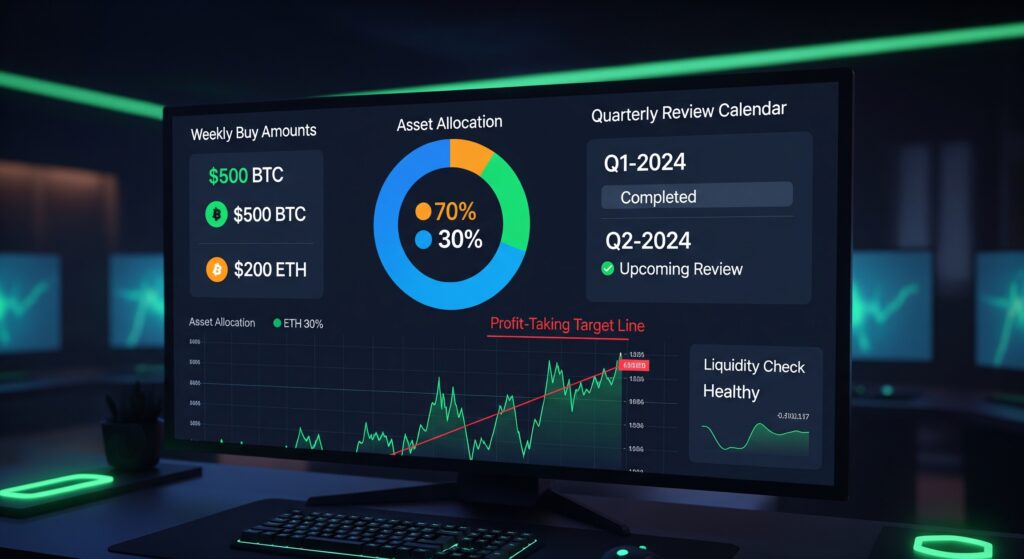
This is the complete dollar cost averaging strategy I’d give anyone starting from scratch today. It’s built specifically to avoid every mistake covered above.
The Asset Allocation
- 70% of your DCA budget → Bitcoin
- 30% of your DCA budget → Ethereum
- Zero altcoin DCA until your Bitcoin and Ethereum positions have run for at least 6 months and you have a solid understanding of what you’re adding
The Schedule
- Weekly, automated, mid-week
- Amount: Whatever you can commit to for 24 months without financial pressure
- Platform: Coinbase or Binance recurring buy — no manual execution
The Liquidity Check (Quarterly)
Calculate your total position value in each asset. Check the coin’s average 7-day trading volume. If your total holding exceeds 1–2% of weekly volume, flag it for exit planning. This check takes 10 minutes and protects your exit.
The Profit-Taking Plan (Set Before You Start)
Define your exit triggers now, while you’re calm:
- Take 20–25% profit when your position is up 3x from average cost basis
- Take another 25% when up 5x
- Reassess remaining position when the fear and greed index holds above 80 for two consecutive weeks
- Never sell everything at once — staged exits protect against selling the bottom of a temporary dip
The DCA Crypto Portfolio Strategy in Practice
- Month 1–3: Build the schedule, automate it, don’t check charts daily
- Month 3–6: First quarterly liquidity and fundamentals review
- Month 6–12: Calculate average cost basis, compare to current price, adjust allocation if needed
- Month 12+: Evaluate profit-taking triggers against your pre-set exit plan
- Throughout: Never pause the schedule because of a price drop. That’s the one rule you don’t break.
FAQ: Dollar Cost Averaging — Every Question Answered
Q: What is dollar cost averaging in investing?
Dollar cost averaging is an investment strategy where you invest a fixed amount of money into an asset at regular scheduled intervals — weekly, biweekly, or monthly — regardless of the current price. Over time, this smooths your average entry price between market highs and lows, reducing the risk of a single badly timed lump sum purchase.
Q: How does dollar cost averaging work in crypto?
When crypto prices are low, your fixed weekly or monthly amount buys more units. When prices are high, it buys less. Over a 12–24 month schedule, your average cost per unit ends up lower than the market’s average price across that same period—giving you a structural advantage over any single-entry investor who had to guess timing correctly.
Q: What is the dollar cost averaging formula?
Average Cost Per Unit = Total Amount Invested ÷ Total Units Purchased. Calculate this quarterly by adding up every buy you’ve made, dividing by total units held. That number is your break-even price — everything above it is profit.
Q: Is dollar cost averaging a good strategy for beginners?
Yes — for the right assets. Applied to Bitcoin and Ethereum with a consistent schedule and a defined exit plan, DCA is the most reliable wealth-building strategy available to crypto beginners. Applied to low-quality altcoins without liquidity checks or fundamentals research, it accelerates losses.
Q: Dollar cost averaging vs. lump sum — which is better for crypto?
For beginners without the experience to identify cycle bottoms, DCA is better. For experienced investors who can identify a proven macro low in Bitcoin’s cycle, lump sum captures more upside. In practice, most people who attempt lump sum entries get the timing wrong and would have been better served by DCA.
Q: Is dollar cost averaging good in a bear market?
It’s most powerful in a bear market. Every scheduled buy during a declining market accumulates more units at lower prices. Every unit bought at a bear market low delivers outsized returns when the next bull cycle arrives. The bear market is where DCA investors build the foundation for bull market profits.
Q: How much should I invest when dollar cost averaging crypto?
Only invest what you genuinely won’t need for 12–24 months. A good starting point is 5–10% of monthly income across all DCA positions. The amount matters less than consistency — a $25/week schedule held for 3 years consistently outperforms a $200/month schedule abandoned after 6 months during a bear market.
Q: What is the best crypto to dollar cost average into?
Bitcoin first, Ethereum second. Both have multi-year proven cycles, institutional adoption, genuine utility, and the liquidity depth to handle meaningful position sizes. Every other crypto carries significantly higher project-specific risk, which makes a long-term DCA commitment harder to justify without ongoing deep research.
Q: How to DCA crypto on Coinbase or Binance?
On Coinbase: Asset page → Buy → Recurring Buy → set amount and schedule → Confirm. On Binance: Earn section → Auto-Invest → select asset, amount, and frequency → confirm. Both platforms handle the automation entirely — no manual intervention needed after setup.
Q: DCA crypto daily vs weekly vs monthly — what frequency is best?
Weekly is the optimal balance for most investors. Daily catches have more price variation, but fees compound on smaller amounts. Monthly works for larger investment sums but gives you fewer data points across the year. A weekly gives you 52 entry points annually — enough to smooth out even the most volatile market conditions.
Q: What did Warren Buffett say about dollar cost averaging?
Buffett has consistently recommended that most non-professional investors should use a consistent, scheduled approach to invest in fundamentally sound, low-cost vehicles. In crypto terms, this directly translates to DCA into Bitcoin — the asset with the most documented institutional credibility and the closest thing to durable fundamental value in the crypto space.
Q: How long should you DCA into Bitcoin?
Minimum 12 months. Optimal 24–36 months. Every 3-year DCA window into Bitcoin since 2013 has ended in profit — including windows that started at cycle tops. Time in the strategy consistently beats timing the strategy.
Q: What is the difference between DCA and lump sum investing?
A lump sum puts all your capital in at one moment. DCA spreads it across scheduled intervals. A lump sum requires correct market timing to maximize returns. DCA eliminates the timing requirement and delivers a smoothed average cost across whatever price range plays out during your investment period.
Final Thought
Dollar cost averaging isn’t a shortcut. It’s not a guarantee. And it won’t save you from choosing a bad asset, ignoring liquidity, or abandoning the schedule the first time the market looks terrifying.
What it will do — if you apply it correctly to the right assets with the right discipline and a defined exit plan — is turn crypto’s most notorious feature against itself. The volatility that destroys most beginners becomes your scheduled advantage. Every crash that triggers panic selling becomes a lower average cost on your accumulating position. Every bear market that empties retail portfolios fills yours quietly, one weekly buy at a time.
The market will always be volatile. People will always panic at the bottom and celebrate at the top. And while they’re reacting emotionally to every candle, you’ll be running a system that benefits from both their fear and their greed.
That’s not just better investing. That’s a fundamentally better relationship with your own money.

Ammar Malik is an independent digital asset researcher and the founder of AmmarMagazine. He specializes in analyzing on-chain security and evaluating technical tools. Through clear, objective crypto resources, Ammar Malik delivers accessible Web3 education to help everyday users navigate the market safely.