
Someone told me about smart contracts years ago over coffee. He’d just gotten burned on a business deal — partner took the advance, disappeared, no contract, no recourse. He said, “I wish there was something that just… forced the agreement to happen. No trust required.”
I didn’t have a good answer then. Now I do.
Smart contracts on blockchain are exactly that. They’re self-executing agreements written in code and stored on a blockchain. When the conditions you set are met, the contract runs automatically — money moves, ownership transfers, access is granted — with zero involvement from a bank, lawyer, escrow agent, or any human middleman. The code just does what it promised.
⚡ Featured Web3 Resource
Verify smart contracts, track on-chain assets, and audit token security instantly using our recommended platform.
Access Verified Web3 Tool →That sounds almost too clean. But stick with me, because the more you understand how this actually works, the more you realize how much of your current financial life is built on people you never chose to trust.
Nobody Shifts to Crypto Without a Reason
And usually that reason comes with some kind of pain attached.
You wired money internationally and watched three days disappear, and a chunk of fees went with it. You waited on a payout from a platform that held it “for security.” You signed a contract with someone and found out the hard way that paper means nothing if the other person decides to disappear.
That frustration is what’s quietly pushing millions of people toward crypto in general — and toward understanding smart contracts on blockchain specifically. Not because it’s trendy. Because the old system has friction baked in by design. Fees, delays, intermediaries — they don’t exist by accident. They exist because someone profits from them.
Smart contracts exist because someone finally asked, “What if we just removed that layer entirely?”
The Vending Machine You Never Thought About
Before I get into the technical side, let me give you the clearest picture I’ve ever found for explaining this.
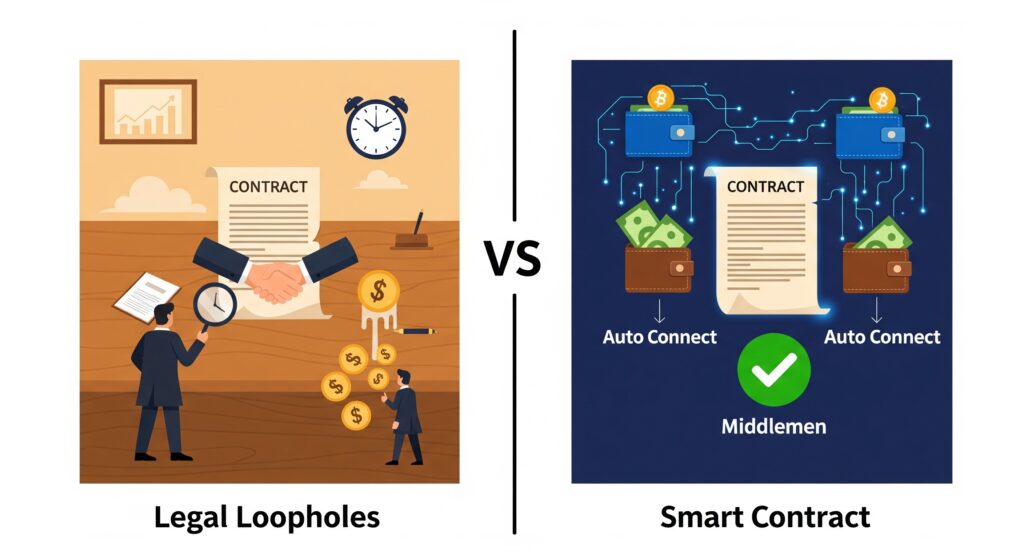
You’ve used a vending machine. You put money in, press a button, and the snack drops. The machine doesn’t know you. Doesn’t care about your credit score. Doesn’t ask for ID or call a supervisor. You fulfilled the condition — money in —, and it fulfilled its side — snack out. Automatically.
A smart contract is a machine, except instead of snacks, it can handle money transfers, property ownership, loan collateral, voting rights, business payments, or anything else with real value attached to it.
The contract sits on a blockchain — meaning it’s not stored on anyone’s server, not controlled by any one company, and once it’s deployed, it can’t be quietly altered. You fulfill your side of the deal; it executes its side. No waiting. No, “We’re processing your request.” No person in the middle skimming a fee.
And here’s the part that took me a while to fully absorb: you don’t have to trust the person on the other side. You trust the code. Because the code is public, verifiable, and mathematically incapable of lying.
My Case — The One That Made Me a Believer
I want to be straight with you because I think the most useful thing I can do is tell you what actually happened, not what sounds impressive.
Early in my freelance days, I delivered a project — weeks of work — based on a verbal agreement and a WhatsApp conversation. The client went quiet. No payment, no response. I chased for months. Eventually got paid less than half just to end the misery. The rest was gone. I told myself it was a lesson in contracts. Wrote better emails. Got better at formal agreements.
Then it happened again. Different client. Proper written contract this time. But the contract was only as useful as my willingness to hire a lawyer and spend more chasing it than the project was worth.
When I first started using platforms built on smart contract-based escrow, something genuinely changed. The client locks the payment into the contract before work starts. Milestone delivered, funds released automatically. There’s no conversation to be had. No, “I’ll pay you next week.” The money is already there, held in code, waiting for the condition to be met.
That experience didn’t just teach me about technology. It changed how I think about trust in business entirely. You don’t need people to be good. You just need the system to be built right.
So What Kinds of Smart Contracts Exist?
Not all of them do the same job. Think of it like this — the same way different types of traditional contracts cover different situations, smart contracts have their own variations depending on what they’re automating.
The legal-style ones are digital versions of agreements you’d normally sign on paper — employment deals, NDAs, and real estate purchases. Researchers have spent a lot of time exploring the path from smart legal contracts to contracts on blockchain because the legal system is still catching up, but the direction is clear. Some jurisdictions already recognize them as binding.
DAOs — Decentralized Autonomous Organizations — are where things get genuinely wild. Imagine a company where the rules are written in code, decisions are made by token holders, and the treasury moves automatically based on votes. No CEO making unilateral calls. No boardroom drama. The governance is the contract.
Application contracts are the ones powering everything you interact with in DeFi. Every time you swap tokens, provide liquidity, or take a crypto loan, a smart contract is running that transaction. The entire liquidity in cryptocurrency ecosystem — trillions of dollars — runs on this type of contract.
Multi-sig contracts need multiple parties to sign off before anything moves. Think of a joint bank account where two people both need to approve a withdrawal — except it’s enforced by code, not a bank’s goodwill.
Where You’re Already Seeing This in the Real World
This is the part where people usually say, “Okay, but does it actually matter outside of crypto?” And I get why — it’s easy to think of blockchain as a niche thing. But the honest answer is that smart contracts are already changing industries that have nothing to do with trading tokens.
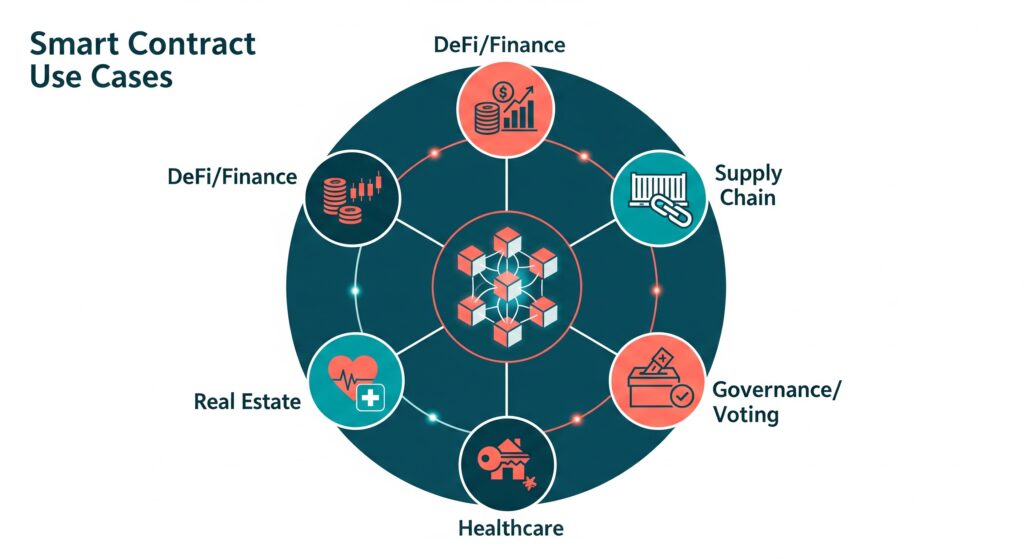
Think about the supply chain. A product leaves a factory in Vietnam. At each checkpoint — port, customs, warehouse, and final delivery — a smart contract verifies the condition and releases payment to the next party automatically. No invoice disputes. No, “We’re still processing.” The conditions are met; the money moves. The impact of blockchain-enabled smart contracts on a firm’s operational efficiency in global supply chains is already being studied seriously because the savings are enormous.
Healthcare is another one. Patient records with consent controls baked directly into the code. Insurance claims that process automatically when the criteria are met, rather than sitting in a queue while someone decides if your claim is “valid.” Clinical trial data that can’t be quietly altered because it’s on a public chain.
Real estate is moving that way, too. Property purchases that can take months of legal back-and-forth are starting to use smart contract-based title transfers. It’s not mainstream yet, but deploying smart contracts in blockchain for property ownership is already real in parts of the US and Europe.
Voting. On-chain voting where every vote is a transaction, permanently recorded, and publicly verifiable. No disputed ballots. No missing boxes. The result is the code output.
Ethereum Built the Playground — But It’s Not the Only One
When people talk about smart contracts on blockchain, they almost always mean Ethereum first — and that’s fair, because it was purpose-built for exactly this. It introduced Solidity, the programming language most developers still use to write smart contracts. Every major DeFi protocol, most NFT projects, and the majority of DAOs live on Ethereum.
But Ethereum has real limitations. Gas fees during busy periods can be brutal. Transaction speed has historically been a pain point. So other blockchains have stepped in and built around those weaknesses.
Solana runs fast — genuinely fast — and at a fraction of the cost. It attracted developers who needed speed for high-frequency applications. Cardano took a slower, more academic route, focusing on formal verification of smart contracts, which basically means mathematically proving the code doesn’t have bugs before it’s ever deployed. That approach appeals to enterprise use. Then there’s Algorand, which has positioned itself as a blockchain platform focused on sustainability and smart contracts for real-world asset tokenization.
Each has tradeoffs. Ethereum has the largest developer community and the most battle-tested protocols. Solana has the speed. Cardano has a security focus. There’s no single “best blockchain for smart contracts” — it depends on what you’re actually building or using.
Can You Actually Make Money With This?
Yes. But not in the way most people imagine when they first ask.
The obvious path people think about is “create a smart contract and get rich.” That’s not really how it works unless you’re a developer launching a protocol. But there are real, practical ways to benefit financially.
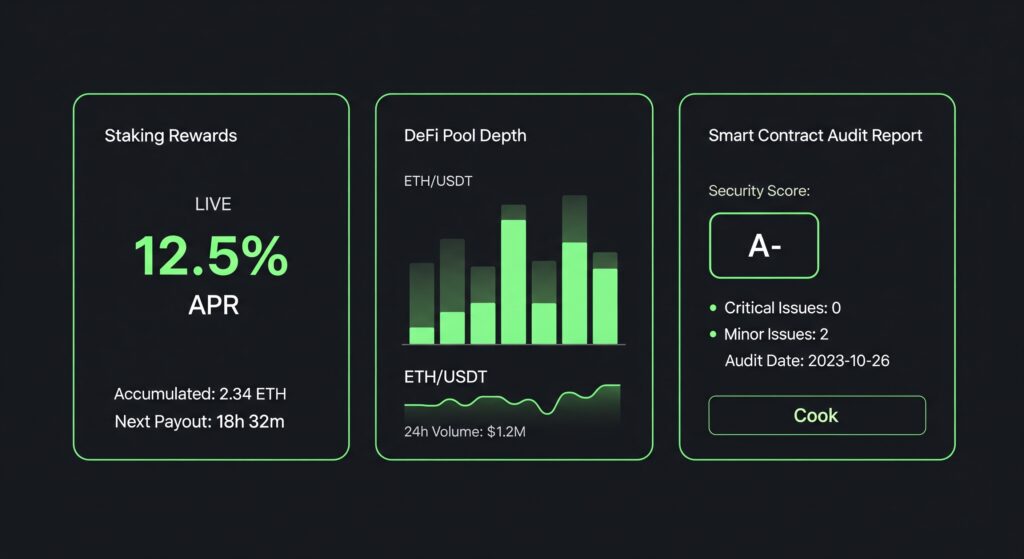
If you’re already holding crypto and sitting on it, staking is worth understanding. You lock your tokens into a smart contract that helps validate the network, and in return, you earn rewards — similar to interest, except the rate is set by code, not a bank deciding what’s profitable for them. No middleman skimming the difference.
DeFi yield is another one. You deposit assets into a liquidity pool — a smart contract that other traders borrow from — and earn a percentage of every transaction that uses your funds. The returns can be meaningful. They can also be volatile. The bear and bull market cycle affects these protocols heavily, and something called impermanent loss can quietly eat your returns if you don’t understand it going in.
If you’d rather invest than participate directly, some of the most significant returns in crypto’s history came from early positions in smart contract protocols. Projects like Uniswap, Aave, and Compound — blockchain smart contracts projects that now handle billions in volume — were accessible to retail investors early. Understanding which protocols have real usage and which are just hype is the actual skill.
And if you can write code, specifically Solidity, the demand for smart contract developers and security auditors is genuinely one of the highest-paying niches in tech right now. A single smart contract audit — reviewing code for vulnerabilities before it goes live — can be worth more than months of traditional software work.
For anyone starting out, the approach I always come back to is dollar-cost averaging into established protocols rather than swinging at new launches. Check the market cap to understand scale. Don’t skip understanding what you’re actually putting money into.
The Side Nobody Wants to Talk About
I’d rather tell you the uncomfortable parts than let you find out the hard way.
The thing that makes smart contracts powerful is also what makes them dangerous. Once a contract is deployed on a blockchain, it’s essentially permanent. If there’s a bug in the code — and bugs happen, even in professional audits — attackers will find it and exploit it. Attacks on smart contracts in blockchain have cost the industry hundreds of millions. The DAO hack in 2016 drained roughly $60 million from what was then one of Ethereum’s most high-profile projects. Not because the blockchain failed. Because the code had a flaw.
There’s also no support line to call. You sent funds to the wrong address, triggered the wrong condition, or got liquidated because the market moved while you were asleep? The code ran as written. That’s not cruelty — it’s just how it works. The decentralization that protects you from being controlled also means nobody can undo your mistake.
And then there’s the data problem. Smart contracts can only access information that lives on the blockchain. When a contract needs real-world data — a price feed, weather conditions, sports scores — it relies on what’s called an oracle. If that oracle is compromised or wrong, the contract executes based on bad information. The code ran perfectly. The outcome was a disaster.
Regulatory uncertainty sits on top of all of it. Governments are genuinely still figuring out where smart contracts fit legally — the shift from smart legal contracts to contracts on blockchain as legally binding instruments is an open question in most countries. What’s completely legitimate in one place might not be in another.
Before you commit serious capital to any DeFi protocol, check the Crypto Fear and Greed Index. When the market is in extreme greed, risk is almost always at its highest. That index won’t save you from everything, but it’ll stop you from making the most expensive mistake at the worst possible time.
What’s Actually Coming Next
AI smart contracts on blockchain are no longer a theoretical conversation. Researchers are actively exploring reinforcement learning with smart contracts on blockchains — contracts that don’t just execute fixed rules but learn, optimize, and adapt based on changing conditions. Imagine a lending protocol that dynamically adjusts its own interest rates based on market behavior, or a trading contract that flags suspicious patterns and pauses itself.
On-chain AI agents are already in early deployment — autonomous programs that manage portfolios, execute arbitrage, and monitor risk without any human clicking a button. The Bitcoin price prediction for 2026 becomes genuinely harder to model when you factor in how much volume is already being moved by algorithmic smart contracts.
This isn’t the future. It’s the early present. And it’s moving faster than most people realize.
Traditional Contract vs Smart Contract — A Straight Comparison
| What You’re Comparing | The Old Way | Smart Contract |
|---|---|---|
| Who executes it | A human, eventually | The code, automatically |
| Anyone can; it’s public | Days, sometimes weeks | Seconds to minutes |
| What it costs | Legal fees, notary, admin | Network gas fees |
| Can you verify it | Usually not | Anyone can, it’s public |
| What if someone makes an error | Renegotiation, maybe court | The code ran as written—no undo |
| Can it be changed | Yes, if both parties agree | No, once it’s deployed |
| Does geography matter | Yes, jurisdiction-dependent | No, it’s borderless |
FAQ
Are smart contracts actually legally binding?
In some places, yes—but it varies significantly. The legal conversation around taking smart contracts on blockchain seriously as enforceable law is ongoing. Some US states and countries like El Salvador and Estonia have moved forward on this. Before you replace a traditional contract with a smart one for anything high-stakes, check your local laws. The technology is ahead of the legislation right now.
Which blockchain should I actually use for smart contracts?
Ethereum if you want the largest developer ecosystem and the most proven protocols. Solana, if speed and cost matter most to your use case. Cardano if you’re drawn to formal verification and a more research-driven approach. Algorand if sustainability and enterprise applications are your focus. None of them are universally “best” — it depends on what you’re building or using.
I don’t code. Can I still use smart contracts?
Absolutely. Platforms like Thirdweb and OpenZeppelin have made it accessible. For basic use cases — staking, DeFi participation, and NFT minting—you interact with smart contracts every time without writing a line of code. If you’re deploying something that holds real value, though, pay for an audit. That’s not optional.
What language do developers use to write these?
Solidity is the main one — it’s what Ethereum runs on and what most developers learn first. Rust powers Solana’s contracts. Vyper is a Python-influenced alternative for Ethereum developers who prefer cleaner syntax. A programming language used to execute smart contracts on a blockchain is always specific to the chain, so what you learn depends on where you’re building.
Where do I start if I want to invest in smart contract projects? Start by understanding what you’re putting money into before you put anything in. Read the protocol’s documentation, check if it’s been audited, and look at its total value. Locked and how that’s trended. Use dollar-cost averaging to build a position over time rather than trying to time entries. Track market cap to understand the protocol’s scale relative to the space. And if you’re still asking yourself whether crypto is right for you at all, start with should I invest in crypto?” Work through that first.
One Last Thought
My friend who got burned on that business deal years ago eventually came back around to this conversation. He’d read about smart contracts, thought it was “still too complicated,” and moved on.
A year later, he watched someone he knew close a real estate deal using a tokenized ownership contract that processed in 48 hours instead of the usual six weeks. No lawyers going back and forth. No title company is holding things up. Two parties, an agreement in code, a blockchain executing it.
He called me and said, “Okay. I get it now.” That’s usually how it works. You don’t fully grasp what smart contracts on blockchain mean until you see what they replace — and feel what it was like to live without them.
The middlemen who slow down your money, your deals, and your trust — they aren’t going anywhere overnight. But the tools to work around them exist right now. Whether you use them or wait until everyone else already has is the only real question left.

Ammar Malik is an independent digital asset researcher and the founder of AmmarMagazine. He specializes in analyzing on-chain security and evaluating technical tools. Through clear, objective crypto resources, Ammar Malik delivers accessible Web3 education to help everyday users navigate the market safely.