
I lost sleep the night I realized a single compromised private key could wipe out everything I’d spent years accumulating. Not because I was careless — I thought I was doing everything right. One wallet, one seed phrase, one point of failure. That’s it. That’s all it takes.
And that’s exactly when I started taking the best multisig wallets seriously.
If you’ve been holding any meaningful amount of crypto — Bitcoin, Ethereum, Solana, whatever — and you’re still relying on a single-key wallet, you’re one phishing attack, one hardware failure, or one stolen device away from losing it all permanently. No bank. No reversal. No customer support.
⚡ Featured Web3 Resource
Verify smart contracts, track on-chain assets, and audit token security instantly using our recommended platform.
Access Verified Web3 Tool →Multi-signature wallets change that game completely.
Why People Are Quietly Moving to Multisig
You won’t hear the average person talking about this at a dinner table. But inside serious crypto circles — DeFi teams, Bitcoin whales, and institutional treasuries — the shift to multi-sig wallet setups has been happening fast.
The reason? As crypto grows, so does the sophistication of the people trying to steal it. Phishing attacks have become nearly indistinguishable from real platforms. Hardware gets lost. People get sick. Keys get forgotten.
A multisig wallet solves all of that by requiring more than one private key to approve any transaction. Think of it like a joint bank account — except instead of two people signing a check, you have cryptographic proof from two or more keys before a single satoshi moves.
That’s not paranoia. That’s responsible ownership of real financial assets.
Why Everyone Holding Crypto Should Care About This
Here’s the honest answer: you don’t need to be managing a $10M DAO treasury to need multisig protection. Even if you’re holding $5,000 in Bitcoin, you deserve the same protection Wall Street uses for billions.
- If you lose one key, your funds are not gone. Other keys can still recover them.
- If someone steals one key, they still can’t move your money alone.
- If you die or become incapacitated, a trusted person or lawyer can still execute access — with your permission built into the wallet’s design.
That’s not a feature. That’s a financial safety net. And I wish I’d used it from day one.
My Own Story with Multisig (And the Mistake Before It)
I’ll be direct with you. I used a standard hot wallet for two years. Single key. Browser extension. I thought hardware wallets were overkill and multisig was “for enterprise.”
Then a friend of mine — someone careful, technically sharp — had his entire Ethereum stack drained through a malicious smart contract approval. Every single token. In one transaction. Because there was only one key needed. No second check. No guardian.
I set up my first 2-of-3 multisig cold wallet the next week. Since then, there has not been a single unauthorized transaction. More than that — I sleep better.
That’s what multisig does for you. It doesn’t just protect your money. It protects your peace of mind.
What Is a Multisig Wallet, Really?
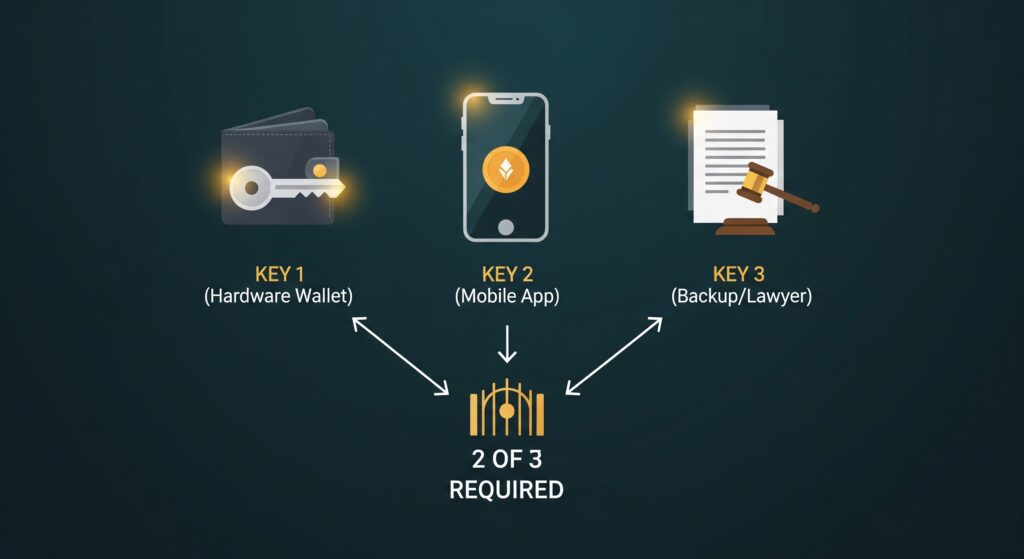
A multisig wallet (short for multi-signature wallet) is a crypto wallet that requires M of N signatures to authorize any transaction. In plain English: you decide how many keys exist and how many of those keys must agree before anything happens.
Common setups:
- 2 of 3: 3 keys exist; any 2 can approve. Best for individuals.
- 3 of 5: 5 keys exist; any 3 must agree. Best for teams and organizations.
- 2 of 2: Both keys must always sign. Most strict — risky if one is lost.
The M-of-N model is the heart of everything that makes a multi signature wallet powerful. It eliminates the single point of failure that makes standard crypto wallets so dangerous at scale.
How to Set Up a Multisig Wallet (Before You Pick One)
Before picking your wallet, understand the setup mindset:
Step 1 — Choose your signer count. For individuals, 2-of-3 is the gold standard. For teams, 3-of-5.
Step 2 — Separate your keys physically. Different devices. Different locations. Never store two keys in the same place.
Step 3 — Test recovery before you fund it. Run a full recovery drill on an empty wallet. Don’t skip this.
Step 4 — Document the setup. Write down which key is where and who holds what — sealed and stored safely. Not digitally.
Step 5 — Pick the right wallet for your chain. Bitcoin multisig works differently from Ethereum multisig. We’ll cover both below.
The 10 Best Multisig Wallets for Onchain Assets in 2026
1. Safe (formerly Gnosis Safe) — Best Multisig Wallet for Ethereum & EVM Chains
If you’re on Ethereum, Polygon, Arbitrum, Base, or any EVM-compatible chain — Safe is the answer everyone serious already uses. It secures over $100 billion in on-chain assets and is trusted by Vitalik Buterin himself, along with hundreds of DAOs and DeFi protocols.
Safe lets you customize signer thresholds, connect hardware wallets like Ledger and Trezor as cosigners, and manage treasury operations with full transparency. It supports 15+ networks with a clean interface that doesn’t require deep technical knowledge to operate.
For teams, protocols, or anyone managing on-chain funds collaboratively, the safe multisig wallet is the industry benchmark — not a recommendation, but a standard.
Best for: Ethereum, EVM chains, DAOs, team treasuries.
Type: Smart contract-based software wallet.
Supported chains: 15+ EVM networks
2. Ledger Flex — Best Multisig Hardware Wallet Overall
Ledger has been in this game long enough to earn serious trust, and the Flex is their sharpest product yet. With CC EAL6+ certification, an E Ink touchscreen, and their HMAC Policy Registration System, this is the best multisig hardware wallet for people who want cold storage with modern usability.
You can plug Ledger Flex into Unchained for Bitcoin multisig, into Safe for Ethereum multisig, or into Caravan for open-source setups. What you see on the screen is what you sign — no hidden transaction manipulation possible.
One thing I appreciate personally: Ledger fixed the long-standing issue where the Bitcoin app couldn’t confirm all multisig details. That’s resolved now with Bitcoin App 2.0. No more blind signing.
Best for: Bitcoin and Ethereum cold storage multisig.
Type: Hardware wallet.
Price: ~$249
3. Electrum — Best Free Multisig Wallet for Bitcoin Power Users
Electrum has been running since 2011. It doesn’t look pretty — the interface genuinely feels like a 2013 relic — but under the hood, it’s one of the most battle-tested Bitcoin multisig tools alive.
It supports P2SH and P2WSH multisig, custom M-of-N thresholds up to 15 signers, XPUB-based setups, and PSBTs. It pairs perfectly with hardware wallets like Trezor, Ledger, and ColdCard. It’s free, open-source, and lightweight.
If you’re a technical Bitcoin holder who wants full control without paying for managed custody services, Electrum is still the go-to best Bitcoin multisig wallet for desktop. Just budget time to learn it.
Best for: Advanced Bitcoin multisig, desktop users.
Type: Open-source software wallet (desktop/mobile).
Price: Free
4. Sparrow Wallet — Best Multisig Wallet for Bitcoin Privacy
Sparrow is what Electrum would be if it had a design team. Open-source, desktop-based, and deeply privacy-focused — Sparrow supports full single-sig and multisig across all Bitcoin script types, PSBT coordination, coin control, and PayJoin.
You can connect it to your own full Bitcoin node for maximum privacy. It’s become one of the community favorites specifically because it gives you total visibility into what’s happening on-chain without hiding anything behind abstraction.
I’ve personally seen Sparrow recommended in every serious Bitcoin security thread in 2025 and 2026. It earned that reputation.
Best for: Bitcoin multisig with privacy, full-node users.
Type: Open-source desktop software wallet.
Price: Free
5. Specter Desktop — Best Open-Source Bitcoin Multisig Coordinator
Specter is a high-quality, watch-only wallet and multisig coordinator that connects directly to a Bitcoin Core node. It’s purpose-built for the security-first crowd who want air-gapped signing, hardware wallet compatibility, and zero reliance on third-party servers.
Specter explicitly recommends separating signing devices across different vendors and locations — a philosophy I deeply agree with. Their 2-of-3 setup guide is one of the clearest in the industry.
If you want a fully self-hosted, open-source, best multisig cold wallet experience on Bitcoin, Specter is the tool.
Best for: Self-hosted Bitcoin multisig, node runners.
Type: Open-source software.
Price: Free
6. Casa — Best Managed Multisig Service for Bitcoin & Ethereum
Casa is what you use when you want multisig without the complexity. They handle the coordination layer, walk you through setup step by step, and give you a 2-of-3 or 3-of-5 setup depending on your plan — using your hardware wallets as signers.
For Bitcoin, they’re one of the most trusted names in guided self-custody. For people who know they need multisig but don’t want to become a Bitcoin engineer to use it, Casa removes the friction without removing your control.
Their inheritance planning feature is genuinely excellent — one of the few services thinking about what happens to your crypto when you’re no longer around.
Best for: Non-technical users who want guided multisig.
Type: Managed multisig service (software + guidance).
Price: Starts at ~$10/month
7. Unchained (Vaults) — Best Multisig Wallet for Bitcoin Long-Term Holders
Unchained’s Vault product is collaborative custody done right. You hold two of the three keys in a 2-of-3 setup; Unchained holds the third as a backup — but they cannot move your funds unilaterally. That’s a critical distinction most people miss.
It’s one of the clearest implementations of sovereign Bitcoin multisig for individuals and businesses who want structure without sacrificing self-custody. Unchained also supports Bitcoin IRAs and collateralized loans — making it genuinely useful beyond just storage.
Best for: Long-term Bitcoin holders, collaborative custody.
Type: Collaborative custody service
Price: Free for basic vaults; premium plans available
8. Trezor Safe 3 / Safe 5 — Best Multisig Hardware Wallet for Budget-Conscious Users
Trezor has always been the open-source alternative to Ledger — and their Safe 3 and Safe 5 models make excellent cosigners in multisig setups. The Safe 5 specifically includes a touchscreen, seed phrase splitting tools, and 2FA passkey functionality.
Trezor devices work as cosigners inside Electrum, Casa, Unchained, Sparrow, and other multisig coordinators. They don’t have native multisig coordinator software, but as a signing device in a larger setup, they’re rock solid.
Safe 3 starts at $79. Safe 5 at $169. Both are open-source and independently auditable.
Best for: Hardware cosigner in Bitcoin multisig setups.
Type: Hardware wallet
Price: $79–$169
9. Bitkey — Best Multisig Wallet for Bitcoin-Only Mobile Users
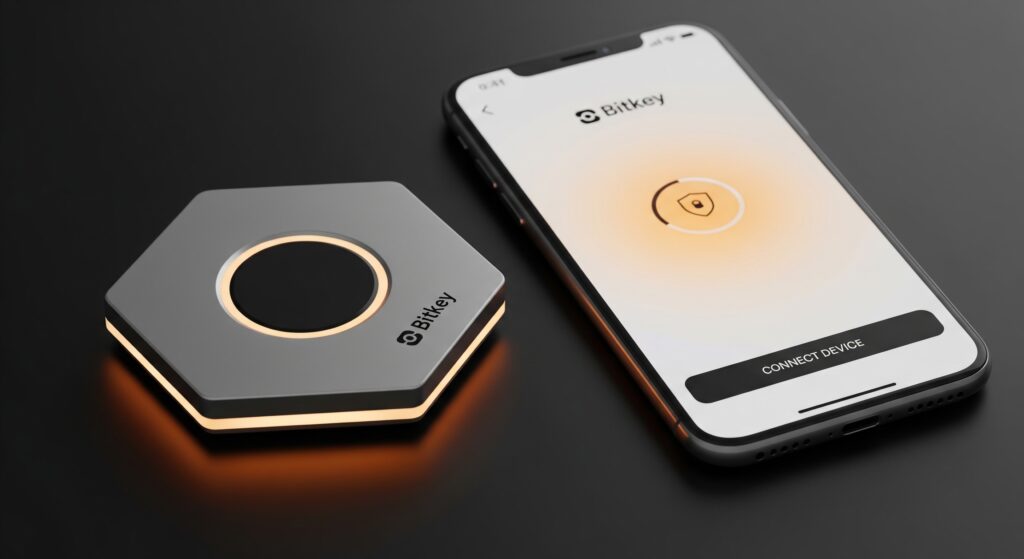
Bitkey is different from everything else on this list — it’s a pocket-sized hexagonal hardware device with a built-in fingerprint reader and a native mobile app. The 2-of-3 setup keeps one key on the device, one in the app, and one encrypted on Bitkey’s server (which they cannot use independently).
It’s designed for Bitcoin-only users who want physical self-custody with mobile convenience. The inheritance system is a thoughtful touch — rare in this space.
At $150, it’s pricier than Trezor but offers a uniquely polished experience for everyday Bitcoin holders who don’t want to become cryptographic engineers.
Best for: Bitcoin-only users wanting simple hardware multisig.
Type: Hardware + mobile app hybrid
Price: $150
10. Nunchuk — Best Multisig Wallet for Bitcoin Teams & Collaborative Signing
Nunchuk rounds out this list as a collaborative Bitcoin multisig wallet built specifically for groups. It supports PSBT-based signing workflows, hardware wallet integration, and a clean mobile/desktop interface that makes multi-person signing actually practical.
For small teams managing a shared Bitcoin treasury — or families doing joint custody of generational wealth — Nunchuk removes the coordination headache without removing the cryptographic guarantees.
Best for: Bitcoin team wallets, family/joint custody.
Type: Software multisig coordinator (mobile + desktop)
Price: Free with optional premium features
Quick Comparison Table
| Wallet | Best For | Chain | Type | Price |
|---|---|---|---|---|
| Safe | EVM teams, DAOs | Ethereum + EVM | Smart contract | Free |
| Ledger Flex | Cold storage multisig | BTC + ETH | Hardware | ~$249 |
| Electrum | Bitcoin power users | Bitcoin | Desktop software | Free |
| Sparrow | Bitcoin privacy | Bitcoin | Desktop software | Free |
| Specter | Self-hosted BTC node | Bitcoin | Desktop software | Free |
| Casa | Non-technical users | BTC + ETH | Managed service | ~$10/mo |
| Unchained | Long-term BTC holders | Bitcoin | Collaborative custody | Free/Paid |
| Trezor Safe 3/5 | Hardware cosigning | BTC + EVM | Hardware | $79–$169 |
| Bitkey | Mobile BTC users | Bitcoin | Hardware + App | $150 |
| Nunchuk | Bitcoin teams | Bitcoin | Software | Free |
Multisig vs. Standard Crypto Wallet — Why It Actually Matters
If you’ve been managing your crypto in a regular crypto wallet, here’s the honest reality: you’ve been flying with no safety net.
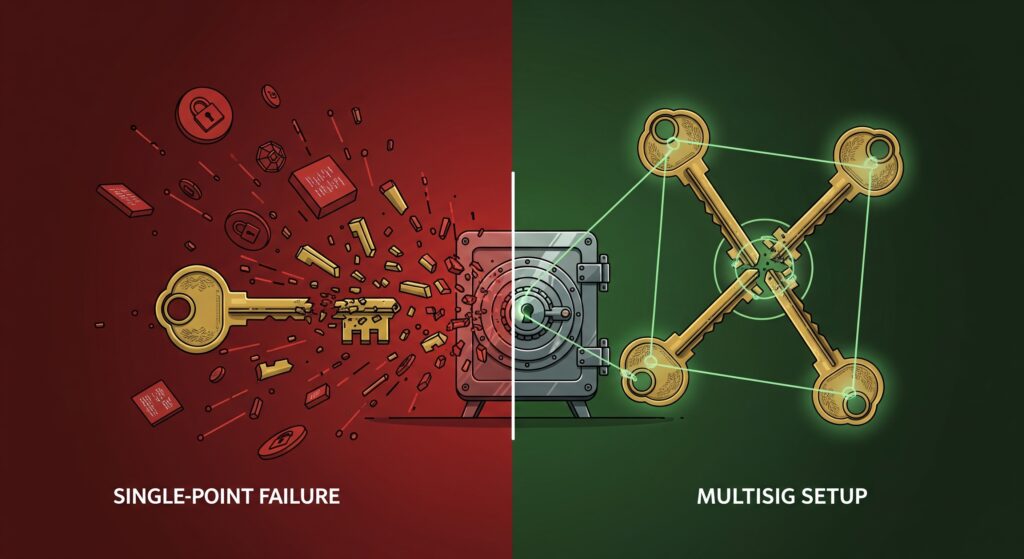
A standard wallet has one private key. Lose it — funds gone. Get phished — funds gone. Someone finds your seed phrase — funds gone.
A multisig wallet requires multiple keys to agree. One key compromised? Nothing moves. One key lost? Other keys handle recovery. One signer dies? The setup can accommodate that, too.
The security difference isn’t marginal. It’s fundamental.
This matters even more as your portfolio grows. Once you’re past the point where losing your holdings would genuinely hurt your life — and if you’ve read our piece on Should I invest in crypto, you know that point comes faster than most expect — single-key wallets stop being appropriate.
A Note on Solana and Tron Multisig
Best multisig wallet Solana and Tron multisig wallet options are more limited than Bitcoin and Ethereum — but they exist. Squads Protocol is the leading multisig solution on Solana, and it’s worth exploring if Solana is your primary chain. For Tron, TronLink supports basic multi-sig configurations.
Neither ecosystem is as mature as Bitcoin or Ethereum multisig — something to factor into your chain selection if long-term security is the priority.
Mistakes I Made (So You Don’t Have To)
I didn’t test recovery first. I set up a multisig wallet, funded it, and then realized my recovery drill never actually worked. Dry run every setup before you put real money in.
I stored two keys in the same location. Defeats the entire point. Keys must be physically separated.
I chose a setup too complex for my situation. A 5-of-7 sounds secure. It also means five people need to coordinate every time you want to make a move. Match complexity to your actual use case.
I didn’t document my setup clearly. Six months later, I couldn’t remember which Ledger was Key 1 and which was Key 2. Write it down. Seal it. Store it safely.
FAQ: Best Multisig Wallets
Q: What is the best multisig wallet for beginners?
Casa is the most approachable option — guided setup, clear interface, and customer support. Bitkey is excellent if you only hold Bitcoin.
Q: What is the best multisig wallet for Bitcoin?
For self-custody purists: Electrum or Sparrow. For managed collaborative custody: Unchained or Casa. For hardware-based: Ledger Flex or Trezor.
Q: What is the best multisig wallet for Ethereum?
Safe (formerly Gnosis Safe) is the industry standard. Nothing comes close for EVM chains.
Q: Is multisig right for small holders?
If your crypto matters to you, yes. The setup is more complex than a standard wallet, but the protection is worth the one-time effort — especially combined with a proper understanding of crypto market cap and portfolio sizing.
Q: Can I use hardware wallets in a multisig setup?
Absolutely. Ledger and Trezor both function as excellent cosigners inside multisig coordinators like Safe, Electrum, Sparrow, and Unchained.
Q: What happens if I lose one key in a 2-of-3 multisig setup?
You still have two keys, which are enough to approve transactions and restore your setup. That’s the entire point of the M-of-N design.
External Links
- Bitcoin Magazine Multisig Guide: https://bitcoinmagazine.com/guides/best-multisig-wallets
- Safe Wallet Official: https://safe.global
Closing Paragraph
Crypto gives you something most financial systems never could: true ownership. No middleman. No bank can freeze your account. No institution decides what you do with your money.
But true ownership comes with true responsibility. And the most dangerous thing you can do with that responsibility is trust it to a single point of failure.
The best multisig wallet isn’t the one with the most features or the shiniest interface. It’s the one that matches your chain, your technical comfort, and your risk profile — and that you’ve actually tested, documented, and know how to recover.
Set it up once, do it right, and your onchain assets can survive anything: hardware failure, theft, loss, even time.
That kind of security isn’t a feature. It’s peace of mind that compounds — just like your crypto should.
Looking to go deeper on wallet security? Read our guide on the best crypto wallets for 2026 and our breakdown of the top 5 hardware wallets — both pair directly with multisig setups.

Ammar Malik is an independent digital asset researcher and the founder of AmmarMagazine. He specializes in analyzing on-chain security and evaluating technical tools. Through clear, objective crypto resources, Ammar Malik delivers accessible Web3 education to help everyday users navigate the market safely.