
So you checked your portfolio, and it’s red. Maybe really red. Before you spiral into “I’ll just never look at this again” mode — stop. That loss you’re staring at can actually work for you on your 2026 tax return, and I’m going to walk you through exactly how to file it, step by step, the way I’ve done it myself more than once.
Here’s the short answer first, because I know you didn’t come here for a novel: you report crypto losses on IRS Form 8949, carry the totals to Schedule D, and you can use those losses to cancel out gains — and even shave up to $3,000 off your regular income each year, with the rest rolling forward into future years. That’s it. That’s the move. Now let’s get into why this actually matters, where people mess it up, and how to do it without losing your mind.
I’ve been managing crypto portfolios and tax strategy for clients (and my own bags) for years now, and if there’s one thing I’ve learned, it’s this: the people who lose the most money on crypto taxes aren’t the ones who made bad trades — they’re the ones who never filed their losses at all. They just assumed a red year meant “nothing to do here.” That’s the most expensive mistake in this whole industry, and I’m not exaggerating.
⚡ Featured Web3 Resource
Verify smart contracts, track on-chain assets, and audit token security instantly using our recommended platform.
Access Verified Web3 Tool →Why People Are Shifting Toward Crypto Investing in the First Place
Let’s back up for a second, because the tax conversation only makes sense once you understand why you’re even here.
People didn’t start buying Bitcoin and Ethereum because they love spreadsheets. They got involved because typical savings accounts yield nearly nothing, inflation eats away at cash lying idle, and cryptocurrency promised something new — the opportunity to grow money quicker, on your own terms, without a bank standing in the middle. I get it. I felt that pull myself the first time I bought into the space.
If you’re still weighing whether this asset class fits your life, I actually broke that whole decision down in “Should I invest in crypto?” — worth a read before you go any deeper here.
Why Everyone Who Holds Crypto Should Understand These Tax Rules
Here’s the part nobody tells you when you’re excitedly buying your first coin: the IRS now sees almost everything. Starting with 2025 trades filed in 2026, every major US exchange is required to send Form 1099-DA straight to the IRS — the same way your stockbroker reports trades. The “nobody’s watching” era of crypto is officially over.
That means whether you made $50,000 or lost $5,000, the IRS already has a copy of your activity. If you don’t report it the same way, you’re not avoiding taxes — you’re inviting a notice. And if you skip reporting your losses, you’re just leaving free money on the table. Nobody should have to pay more tax than they legally owe, and that’s exactly what happens when losses go unfiled.
This applies to you even if:
- You only traded on one exchange
- You lost money overall for the year
- You never withdrew anything to your bank account
- You think your amount is “too small to matter.”
I’ll be honest with you — I used to think small losses weren’t worth tracking either. That was a mistake. Every dollar of loss can offset a dollar of gain elsewhere in your life, even stock market gains. It adds up faster than you might think.
My Own Case Study: The Year I Almost Didn’t File My Losses
A few years back, I had a rough trading year. A handful of altcoin positions I was confident about just didn’t pan out, and by December I was sitting on a loss of a little over $4,000. My first instinct, honestly? “It’s a loss, there’s nothing to report, I’ll just move on.”
I was wrong, and it cost me almost a full year before I corrected it.
When I finally sat down and ran the numbers properly — using a proper cost basis for every trade, pulling CSVs from each exchange, and filling out Form 8949 correctly — I realized that loss offset gains I’d made earlier that same year in a completely different stock position. On top of that, I still had leftover loss to deduct $3,000 against my regular income, and the rest carried forward into the next year to use again.
That one decision to actually file it properly put real money back in my pocket. Not reporting it would have meant quietly handing the IRS a bigger check than I owed, for no reason at all. That mistake taught me something I now tell every person I work with: losses are not something to ignore — they’re an asset you’ve already paid for emotionally, so you might as well collect the tax benefit too.

How Crypto Taxes Actually Work in 2026 (The Part Most Guides Skip)
Before we get into filing losses specifically, you need the foundation. The IRS treats crypto as property, not currency — the same category as stocks or real estate. That single classification is the root of every rule that follows.
You owe tax (or can claim a loss) when you:
- Sell crypto for cash
- Trade one crypto for another (yes, even BTC to ETH counts)
- Spend crypto on goods or services
- Receive staking, mining, or airdrop rewards (taxed as income, not capital gains)
You don’t trigger anything when you:
- Buy crypto and just hold it
- Move crypto between your own wallets
- Buy crypto with regular dollars
This is exactly why I always tell people building a long-term position to read up on dollar-cost averaging — steady buying doesn’t create a taxable mess; it just quietly builds your position.
Crypto Tax Rates for 2026
| Holding Period | Tax Treatment | 2026 Rate Range |
|---|---|---|
| Held 1 year or less (short-term) | Taxed as ordinary income | 10% – 37% |
| Held more than 1 year (long-term) | Preferential capital gains rate | 0%, 15%, or 20% |
| Staking, mining, airdrops | Ordinary income at fair market value when received | 10% – 37% |
| Crypto losses | Offset gains, then up to $3,000 against regular income | N/A — deduction, not a rate |
The gap between short-term and long-term rates is enormous. On a meaningful gain, holding just past the one-year mark instead of selling early can be the difference between handing over 37% and handing over 15%. That’s not a minor detail — that’s the single biggest lever most people never pull. If you want to go deeper on reading the market cycles to decide when to hold versus sell, my breakdown of the bear and bull market cycle pairs really well with this.
How to Actually File Crypto Losses, Step by Step
Okay, here’s the part you came for. This is the exact process I walk through every tax season.
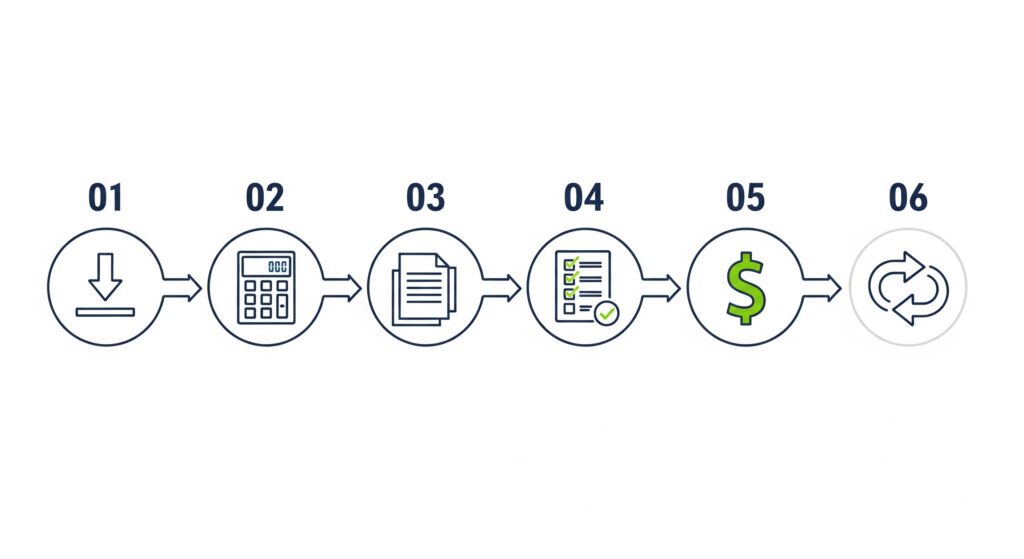
Step 1: Pull your full transaction history. Download CSVs from every exchange and wallet you used during the year — Coinbase, Kraken, MetaMask, whatever it is. Don’t trust your memory. I’ve seen people forget an entire exchange they used two years ago, and it threw their whole basis off.
Step 2: Calculate cost basis for every disposal. For each sale or trade, you need the date you bought it, what you paid, the date you sold it, and what you got for it. The difference is your gain or loss. This is genuinely the most tedious part, and it’s where most manual filers make mistakes — especially with assets transferred between exchanges, since the receiving platform often doesn’t know your original purchase price.
Step 3: List every transaction on Form 8949. Every disposal — even the losing ones — gets its own line. Short-term and long-term trades go in separate sections of the form.
Step 4: Total everything on Schedule D. This is where your gains and losses net against each other. If your losses exceed your gains, you’ve got a net capital loss.
Step 5: Deduct up to $3,000 against ordinary income. If you’re still showing a net loss after offsetting gains, you can deduct up to $3,000 ($1,500 if married filing separately) against your regular income for the year.
Step 6: Carry the rest forward. Got more loss than that $3,000 cap can use up? It doesn’t disappear. It rolls forward to next year and the year after until it’s fully used.
This is exactly why having clean records matters so much — and honestly, doing this by hand for an active trading year is rough. This is where good crypto tax software earns its keep. It pulls your full history automatically and spits out IRS-ready forms instead of you cross-referencing fifteen spreadsheets at midnight in April. If your budget’s tight, I also put together a list of free crypto tax software options that handle the basics without costing you anything.
A Strategy That Quietly Saves People Thousands: Tax-Loss Harvesting
Here’s something most people don’t realize, and it genuinely surprised me the first time I learned it: crypto is not currently subject to the “wash sale” rule that applies to stocks. With stocks, if you sell at a loss and buy the same asset back within 30 days, the IRS disallows that loss. With crypto, as of right now, that rule doesn’t apply.
What does that mean practically? You can sell a coin that’s down, lock in the loss for tax purposes, and immediately buy it right back — keeping your position while still claiming the deduction. This is called tax-loss harvesting, and it’s one of the few genuinely legal “loopholes” left in personal finance.
I’ll be straight with you, though: this rule has been under review by lawmakers for a while now, and it could close. Don’t build your entire strategy around it lasting forever — use it while it’s available, but don’t treat it as a permanent fixture.
Mistakes I’ve Made (So You Don’t Have To)
- Ignoring small transactions. I used to skip “tiny” trades under $50 because tracking them felt pointless. Multiply that by 40 trades, and you’ve got a real reporting gap.
- Trusting exchange-reported numbers blindly. Your 1099-DA might show your sale proceeds but not your actual cost basis, especially for assets you transferred in from another platform. If you copy that number straight onto your return without checking it, you could overpay by a lot.
- Waiting until April to start. Reconciling a full year of DeFi swaps, staking rewards, and trades in a weekend is miserable. Start in January.
- Assuming “I didn’t sell” means “I don’t report anything.” If you only bought and held, you generally have no taxable event — but if you earned staking rewards or an airdrop anywhere along the way, that’s still reportable income.
Comparing Your Filing Options
| Method | Best For | Effort Level | Cost |
|---|---|---|---|
| Manual filing (spreadsheets) | A handful of trades, one exchange | High | Free, but time-heavy |
| Crypto tax software | Active traders, multiple exchanges/wallets | Low | $50–$300/year typically |
| Hiring a crypto-savvy CPA | Large gains/losses, DeFi, business income | Lowest (for you) | $300+ |
If your year was simple — a few trades on one platform — you can probably handle Form 8949 yourself with a spreadsheet and a calm afternoon. If you touched DeFi, multiple wallets, or staking rewards, do yourself a favor and use software or a professional. I promise the few hundred dollars it costs is cheaper than the hours you’ll burn (or the mistakes you’ll make) doing it manually.
Frequently Asked Questions
If you sell crypto at a loss, do you pay taxes? No — a loss isn’t taxed. In fact, it can reduce your tax bill by offsetting gains elsewhere and up to $3,000 of regular income per year.
Do you pay taxes on crypto before withdrawal? Yes, if you sold or traded it. The tax event happens at the moment of the sale or trade, not when you move the cash to your bank account.
Do you have to report crypto on taxes if you don’t sell? Generally no, for simple buy-and-hold positions. But if you earned staking rewards, mining income, or an airdrop, that’s reportable as income even without selling.
Do I need to report crypto on taxes if it’s less than $600? Yes. The $600 threshold applies to when exchanges are required to send you a form — it has nothing to do with your personal obligation to report. Every taxable transaction counts, regardless of size.
How do I avoid capital gains tax on cryptocurrency legally? Hold assets for more than a year to qualify for lower long-term rates, harvest losses to offset gains, and consider donating appreciated crypto to charity (which can avoid the gain entirely while still giving you a deduction).
What happens if I don’t report my crypto losses? Nothing bad happens to you directly — but you’re voluntarily giving up a deduction you’ve already “paid for” with real losses. It’s the one tax mistake that costs you money for doing nothing.
One Last Thing Before You Go
Filing crypto losses isn’t fun; I won’t pretend otherwise. But it’s one of the few moments in this whole crypto journey where a rough year on the charts can actually hand you something back. Don’t let a red portfolio turn into a red tax return too.
Grab your transaction history this weekend, even if April feels far away. Future you — the one staring at a tax bill — will be glad you did it early instead of scrambling.
This article is for general information only and isn’t personalized tax or financial advice. For guidance specific to your situation, talk to a licensed tax professional or refer to the official IRS Digital Assets guidance.

Ammar Malik is an independent digital asset researcher and the founder of AmmarMagazine. He specializes in analyzing on-chain security and evaluating technical tools. Through clear, objective crypto resources, Ammar Malik delivers accessible Web3 education to help everyday users navigate the market safely.