Here’s the short answer to how liquidity in cryptocurrency kills portfolios: when you buy a coin with no real buyers on the other side, you become the exit for someone else. You push the price up with your buy, they sell into it, and when you try to leave, there’s nobody there to buy from you. That’s not bad luck. That’s a liquidity trap, and it happens every single day to people who never even heard the word “liquidity” before they lost money. Now let me show you the full picture—because once you see it, you can never unsee it.
Why Do People Come to Crypto in the First Place?
Nobody enters a volatile market because they love stress. People come to crypto because something in their current financial situation stopped working. The salary that used to feel enough now doesn’t cover inflation. The savings account is a joke. The stock market feels rigged for people with Bloomberg terminals and teams of analysts.
Crypto offered something different—a market where a regular person with a phone and $500 could make moves that, in traditional finance, required a broker, a minimum balance, and a waiting period. That accessibility is real. That opportunity is real.
⚡ Featured Web3 Resource
Verify smart contracts, track on-chain assets, and audit token security instantly using our recommended platform.
Access Verified Web3 Tool →But the same openness that lets you in also lets in coins with zero buyers, projects with locked liquidity that unlock the moment you invest, and pools that drain faster than they fill. Nobody warns you about that part in the YouTube thumbnails.
Why You Still Need to Be in This Market
Here’s the thing I tell everyone who asks me whether crypto is worth it after they’ve been burned: the problem was never crypto. The problem was entering without understanding the rules of the game.
Liquidity in cryptocurrency isn’t a flaw in the system. It’s actually one of the most useful filters you’ll ever learn. Once you understand it, you stop chasing shiny coins and start asking a single question before every trade: Can I actually get out of this?
That question alone will save your portfolio more times than any indicator ever will.
And if you’re still building your understanding of how markets move against you, my piece on Bear and Bull Market Traps the 1% Use Against You connects directly to this—liquidity is one of the core weapons used in those traps.
My Personal Case Study: The Altcoin I Couldn’t Sell
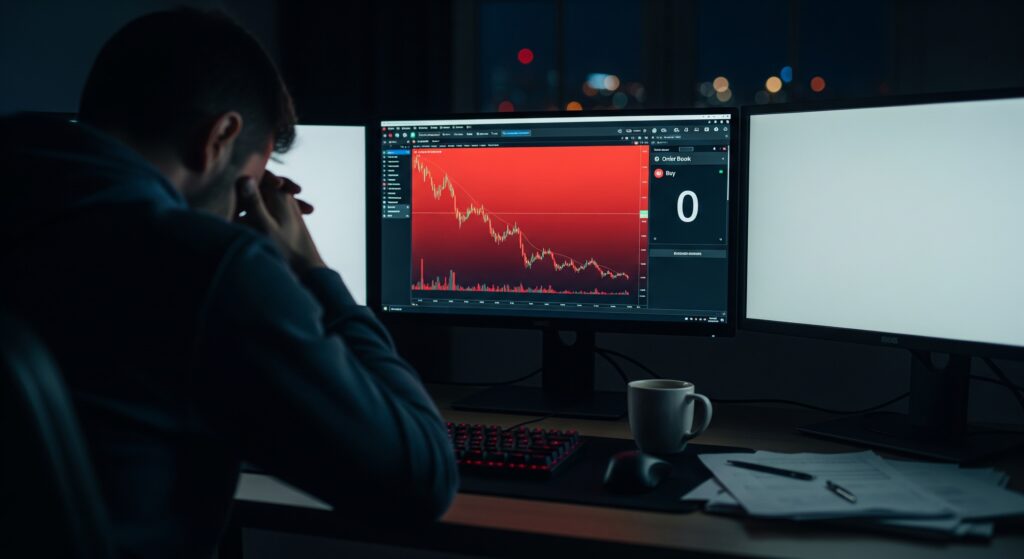
Let me tell you about a token I found in 2022. New project, solid-looking whitepaper, active Telegram, and a chart that had already moved 300% in two weeks. I did what most people do — I looked at the price action and felt the FOMO. I bought a position worth around $1,800.
What I didn’t check: the crypto market liquidity on that token. The 24-hour trading volume was under $80,000. The order book had maybe six buy walls, all of them thin. I was one of the largest buyers that day without even knowing it.
The price kept climbing for three more days. I was up 60%. I felt like a genius.
Then I tried to sell. My sell order was so large relative to the available buyers that the moment I hit confirm, my own sell crashed the price by 22% before it even filled. I ended up exiting at a loss on a trade that was green 60% the day before.
That’s crypto slippage doing what it does when liquidity is thin. And that day I swore I’d never enter another trade without checking the order book depth first.
So What Does Crypto Liquidity Actually Mean?
What does crypto liquidity mean in plain language? It means: how easily can you buy or sell a coin without your own trade moving the price against you?
High liquidity = lots of buyers and sellers, tight spreads, and your order fills close to the price you saw.
Low liquidity = thin order books, wide spreads, your order moves the market, and you pay for it.
Think of it like selling a house in a busy city versus selling one in the middle of nowhere. The city house sells fast, close to the asking price. The remote house either sits for months, or you drop the price until someone bites. Crypto’s low liquidity is that remote house—except the price can drop in minutes, not months.
Why Is It Called Liquidity?
The word comes from finance—assets that can be quickly converted to cash without losing value are “liquid.” Water flows freely; it takes the shape of whatever contains it. A liquid market flows the same way—money moves in and out without friction. A market with poor liquidity is frozen. You’re stuck in whatever shape you entered.
The 5 Ways Liquidity in Cryptocurrency Kills Portfolios
This is the part most articles skip or bury. I’m putting it front and center because this is where the real damage happens.
1. You Become Someone Else’s Exit Liquidity

Crypto exit liquidity is the most brutal concept in this space—and almost nobody talks about it directly.
When a whale or early investor wants to sell a large position, they can’t just dump it. That would crash the price, and they’d lose money on their own exit. So what do they do? They create a narrative. Social media posts, influencer promotions, fake volume, and a news cycle. Retail traders pile in—buying the hype—and the whale sells into their buys.
You’re not investing when this happens. You’re providing the exit for someone who got in at 10x below your entry.
How to spot it:
- Sudden social media explosion on a coin with no new development
- Volume spike with no corresponding improvement in fundamentals
- Price pumps fast, but the crypto fear and greed index is already at Extreme Greed (link this to the Fear & Greed Index article)
- Large wallets show outflows on-chain, while retail wallets show inflows
2. Slippage Eats Your Returns Before You Even Notice
Slippage is the difference between the price you expected and the price you actually got. On a liquid coin like Bitcoin or Ethereum, slippage on a $5,000 trade is maybe 0.1%. Barely noticeable.
On a crypto low liquidity altcoin? That same $5,000 trade can slip 5%, 10%, or sometimes 20%. You’re paying a hidden tax every time you enter and every time you exit—and on thin markets, that tax compounds silently.
I’ve run the numbers on past trades where slippage alone cost me more than my gas fees, trading fees, and spread combined. It’s invisible until you calculate it. Then it’s infuriating.
What to do: Before entering any position, check the order book depth. If your trade size is more than 1–2% of the 24-hour volume, you’re going to move the market. Either reduce your size or avoid the trade.
3. Crypto Locked Liquidity—The Rug Pull Setup

Crypto-locked liquidity sounds safe. And sometimes it is. When a project locks its liquidity in a pool for 12 months, it signals they’re not going to pull the funds immediately—that’s a basic legitimacy check.
But here’s what they don’t tell you: locked liquidity only protects against immediate rug pulls. It doesn’t protect you from:
- The lock expiring and the team withdrawing everything at once
- The token has no buyers when the lock lifts and price collapses naturally
- A partial lock where only 20% of liquidity is locked, and 80% is free to move
- Smart contract exploits that bypass the lock entirely
Always check how much is locked, where it’s locked (use a platform like Unicrypt or Team.Finance), and when it unlocks. If the unlock date is coming up in 30 days and you’re holding—that’s your warning.
4. Crypto Liquidity Pools and Impermanent Loss
If you’ve ever provided liquidity to a crypto liquidity pool — especially on platforms like Uniswap, PancakeSwap, or Curve Finance — you need to understand impermanent loss. This is the part that makes people feel robbed even when the pool is “working.”
When you deposit two tokens into a liquidity pool, the pool automatically rebalances as the price ratio changes. If one token pumps hard, you end up holding more of the weaker token and less of the one that ran. When you withdraw, you have less value than if you’d just held both tokens separately.
It’s called “impermanent” because if prices return to their entry ratio, the loss disappears. But in crypto, prices rarely return. And most people withdraw into the loss.
The fix: Only provide liquidity to stable pairs (like USDC/USDT) or pairs you’d hold anyway. And always calculate your impermanent loss before committing, using a tool like dailydefi.org.
5. Low Liquidity Altcoins in a Bear Market
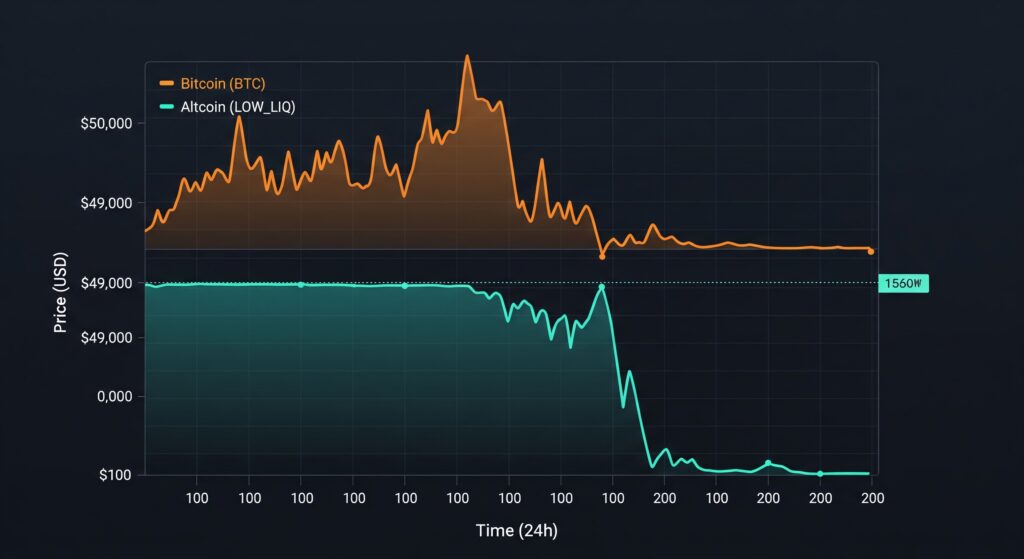
Alt Text: Crypto market liquidity chart comparing Bitcoin’s stable liquidity line against a low liquidity altcoin crashing during a bear market
This one is silent and slow, which makes it worse.
When a bear market sets in (link this to the Bear and Bull Market Traps article), liquidity dries up across the board. But it doesn’t dry up equally. Bitcoin keeps trading billions per day. Altcoin liquidity evaporates. Projects that had $5M in daily volume in a bull run are doing $200k on a bad bear market day.
What does that mean for you? It means the exit you planned in your head doesn’t exist anymore. The buyers aren’t there. You can either sell at a catastrophic loss or hold and pray the next bull run brings them back.
Some projects never come back. Their liquidity died with the bear market and never recovered.
Understanding where we are in the market cycle is critical for liquidity planning. My Bitcoin Price Prediction 2026 breakdown gives you key levels to watch—those levels directly impact when altcoin liquidity returns.
How to Check Crypto Liquidity Before You Buy
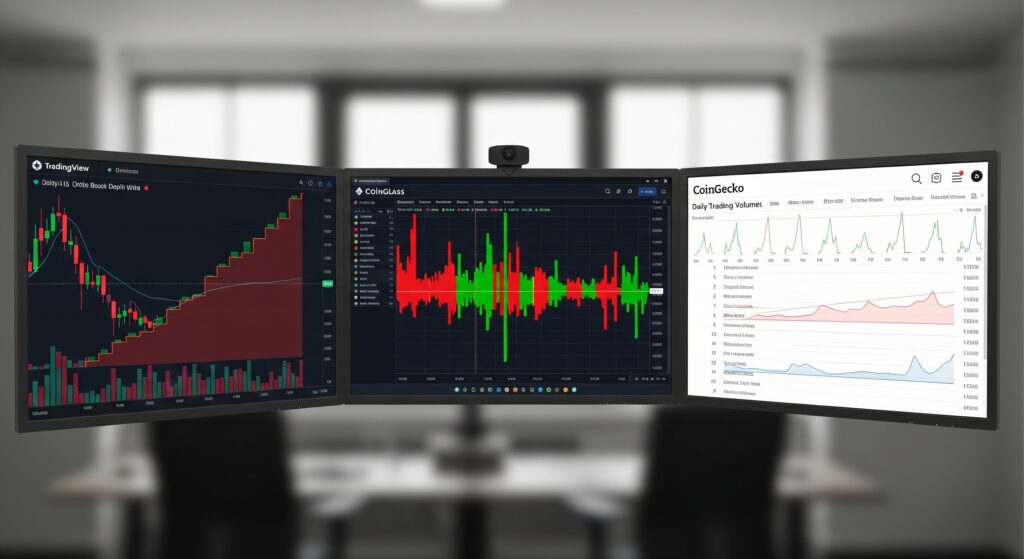
Here’s the actual workflow I use before entering any position. This takes about 4 minutes and has saved me from bad trades more times than I can count.
Step 1 — Check 24-hour volume on CoinGecko or CoinMarketCap: Your position size should be under 1% of the 24-hour volume. If you want to put $2,000 into a coin doing $50,000 in daily volume—stop. That’s a 4% position in the daily flow. You will move the market.
Step 2 — Open the Order Book on the Exchange: Look at the depth on both sides. Are there thick buy walls below the current price? Or is it a cliff? Thin buy support means if anyone sells before you, the price drops fast, and your exit gets worse.
Step 3 — Check the Liquidity Heatmap on Coinglass: The crypto liquidity heatmap on Coinglass shows you where large clusters of buy and sell orders are sitting across the market. It’s free to use, and it shows you exactly where the price is likely to get pulled up toward sell liquidity or down toward buy liquidity. This is one of the most underused tools in retail trading.
Step 4 — Use a Crypto Liquidity Tracker for Ongoing Monitoring: For coins you’re already holding, set up alerts. If the 24-hour volume drops below a certain threshold, that’s your signal to reassess the position—not panic, just reassess.
Step 5 — For DeFi Pools, Calculate the Pool Depth How to calculate crypto liquidity in a DeFi pool: Look at the total value locked (TVL) in the pool relative to the trading volume. A pool with $500k TVL doing $2M in daily volume has high turnover—that’s healthy. A pool with $500k TVL doing $10k in daily volume is stagnant—exit risk is high.
The Killer Strategy: Trade Liquidity, Not Just Price
Most people look at a chart and ask, “Is the price going up?”
The right question is: Is there enough liquidity for me to get in and out profitably?
Here’s the framework I now use on every trade:
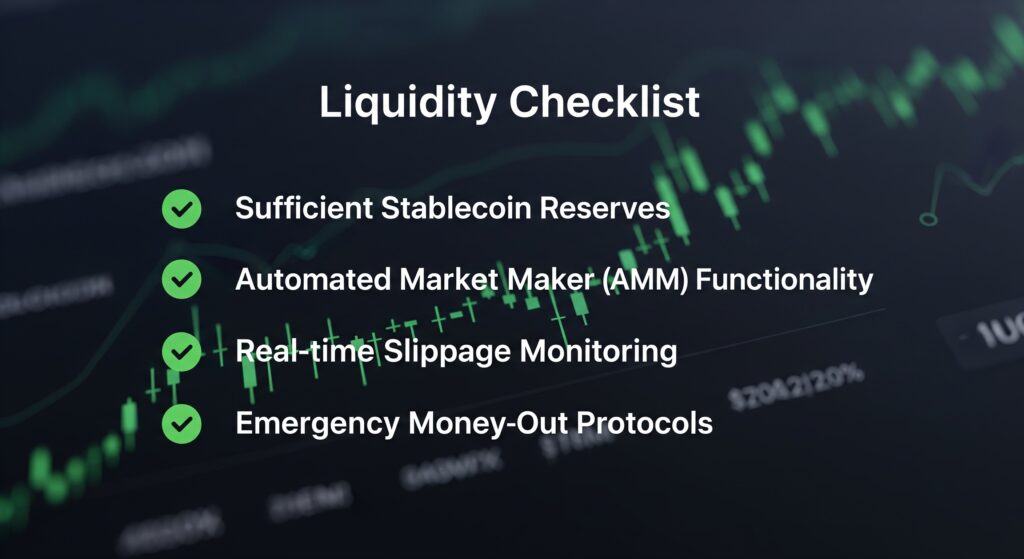
The Liquidity Checklist (Run This Before Every Entry)
- 24-hour volume is at least 100x my intended position size
- The order book shows real depth—not just one or two thin walls
- CoinGlass heatmap shows buy liquidity below the current price, not a void
- Project liquidity is not locked with an upcoming unlock in the next 60 days
- I’ve checked if the coin is listed on a crypto ETF or institutional product—institutional backing = deeper liquidity
- Crypto coins with high liquidity are preferred for larger positions; low liquidity plays are capped at 2–3% of my total portfolio
- I’ve identified my exit before my entry—and the exit is realistic given the current order book depth
The last point is the one that changed everything for me. Most traders plan entries. Almost nobody plans exits with the same rigor. And in a crypto low liquidity environment, the exit is the whole game.
Understanding Crypto Market Liquidity vs Volume — They’re Not the Same
This is a mistake I see constantly—even from people who’ve been trading for years.
Volume = how much of a coin was traded in a period of time. Liquidity = how much can be traded right now without moving the price.
A coin can have high volume and low liquidity. This happens when a small group of wallets is trading back and forth between themselves—creating the appearance of activity. It’s called wash trading, and it’s common in low-cap coins trying to look legitimate.
How does crypto liquidity work in practice? The order book is the real-time snapshot of liquidity. Volume is the historical record of what traded. Always trust the order book over the volume number—the order book shows you what’s available right now, not what happened yesterday.
For context on how market cap connects to liquidity—a higher market cap generally means deeper liquidity, but it’s not a guarantee (link this to the Market Cap article). I broke down exactly how market cap works and why it matters for decisions like this.
FAQ: Liquidity in Cryptocurrency
Q: What is the difference between liquidity and volume in crypto?
Volume tells you how much was traded over a set period. Liquidity tells you how much you can trade right now at the current price without moving it. Volume is historical. Liquidity is live. Both matter, but liquidity is what protects your exit.
Q: What is exit liquidity in crypto?
Exit liquidity is when retail traders buy into a position specifically so that earlier investors — usually whales or team members — can sell their holdings without crashing the price. If you’re buying a hyped coin late in the cycle, there’s a real chance you’re providing the exit for someone who got in at a fraction of your price.
Q: How do I check crypto liquidity before buying?
Check the 24-hour trading volume on CoinGecko or CoinMarketCap, look at the live order book depth on your exchange, and use the crypto liquidity heatmap on Coinglass to see where large order clusters sit. Your position size should stay under 1% of the daily volume.
Q: Are crypto liquidity pools safe?
They carry specific risks—mainly impermanent loss and smart contract vulnerabilities. Stable pairs (like USDC/USDT) carry lower risk. Volatile pairs in new protocols carry much higher risk. Never provide liquidity with money you can’t afford to hold for an extended period.
Q: What does low liquidity mean for my crypto portfolio?
It means your exits become unreliable. You may be unable to sell at the price you want, your sell order may move the price against you (slippage), and in a bear market, buyers may disappear entirely. Low liquidity positions should be a small percentage of your total portfolio.
Q: What are crypto coins with high liquidity?
Bitcoin (BTC), Ethereum (ETH), BNB, Solana (SOL), USDT, and USDC are the most liquid crypto assets. Among altcoins, coins listed on major exchanges like Binance, Coinbase, and Kraken with consistent daily volume above $50M are considered reasonably liquid.
Q: What is a crypto liquidity provider?
A liquidity provider in crypto is a person or entity that deposits funds into a trading pool or exchange order book to enable smoother trading. In DeFi, liquidity providers deposit token pairs into pools and earn trading fees in return. In centralized exchanges, market makers act as liquidity providers by placing both buy and sell orders.
Final Thought
Liquidity isn’t the most exciting thing to study in crypto. It doesn’t have the drama of a 10x altcoin or the headlines of a Bitcoin halving. But it is the thing that determines whether your good trades actually pay you—or whether they just look good on paper until the moment you try to leave.
Every experienced trader I know has a liquidity horror story. A coin they couldn’t sell. An exit that cost them more than their gains. A pool that drained while they weren’t watching. These aren’t rare events. They happen to smart people who simply didn’t ask the right question before entering.
You now know the question. Ask it every single time.
The market will always have opportunities. Make sure you can actually reach them—and leave with the profit.

Ammar Malik is an independent digital asset researcher and the founder of AmmarMagazine. He specializes in analyzing on-chain security and evaluating technical tools. Through clear, objective crypto resources, Ammar Malik delivers accessible Web3 education to help everyday users navigate the market safely.