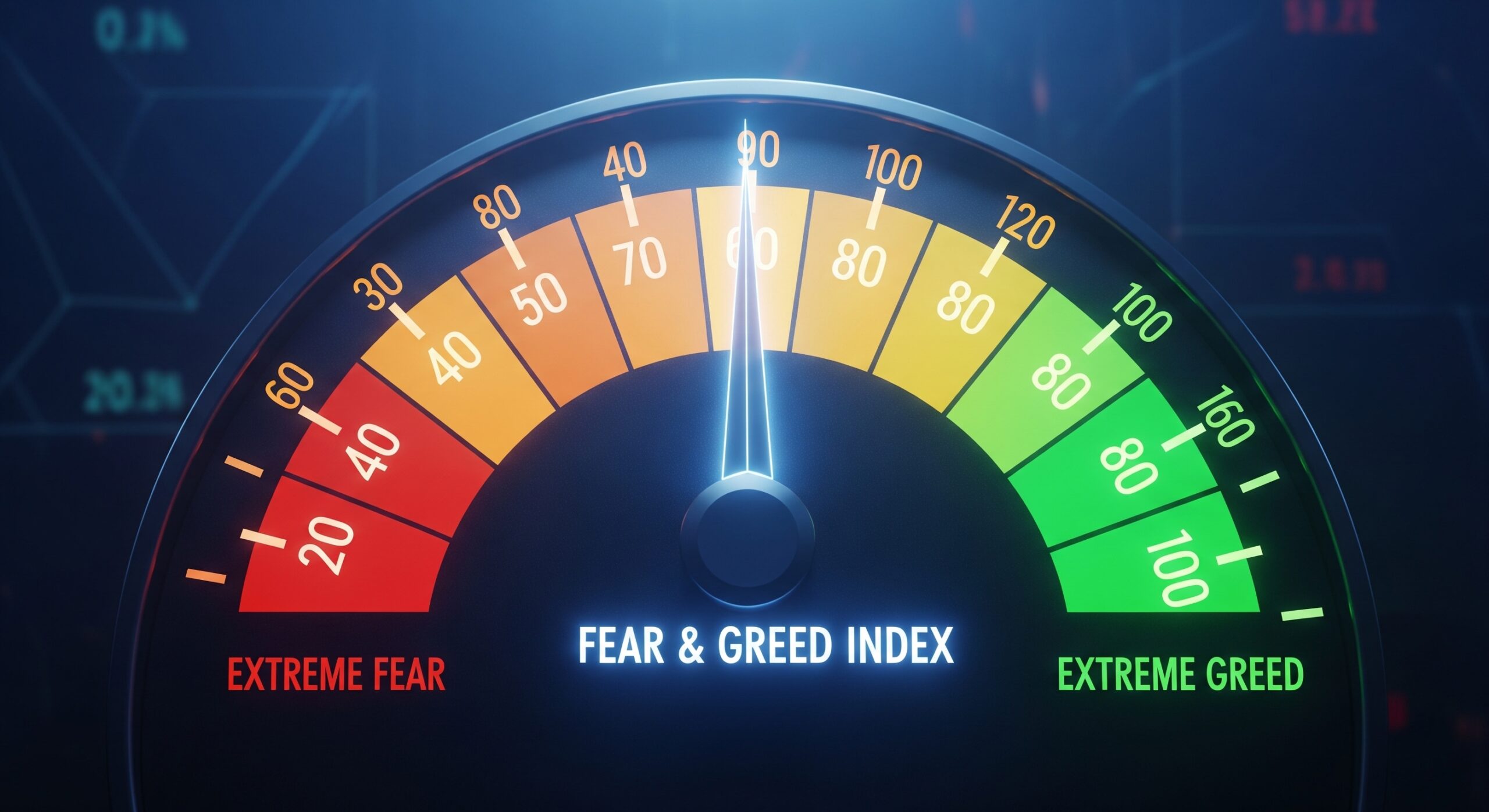
Okay, so real talk—when I first got into crypto, I was doing what literally everyone does.
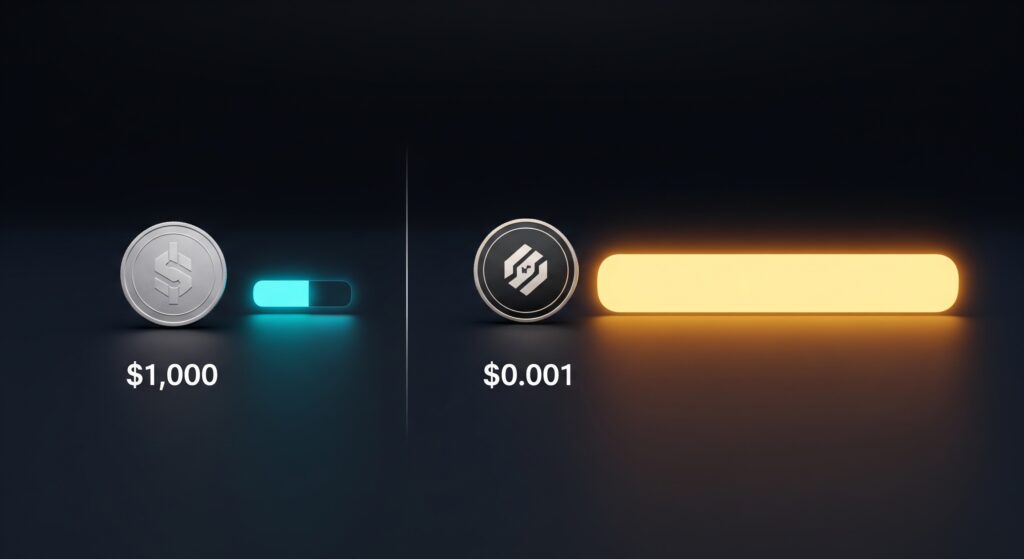
I’d open CoinMarketCap, scroll past Bitcoin and Ethereum, and go straight for the coins priced at $0.001 or $0.003. My logic was simple: if this thing even hits a dollar, I’m retired.
Sounds familiar, right?
⚡ Featured Web3 Resource
Verify smart contracts, track on-chain assets, and audit token security instantly using our recommended platform.
Access Verified Web3 Tool →Here’s the problem. I didn’t know what market cap was. And that one gap in my knowledge was costing me before I even pressed buy.
Let me save you from that exact mistake.
“Wait—What Even Is Market Cap?”
Alright, so your friend asks you this at dinner. How do you explain it without sounding like a Wikipedia article?
You say, “It’s basically the total size of a coin—not just the price, but the whole thing.”
More specifically, market cap is the price of a coin multiplied by how many coins are actually out there in circulation.
That’s the whole formula. Seriously.
So if a coin costs $10 and there are 50 million of them floating around in the market, that coin’s market cap is $500 million. Done. No calculus required.
Now here’s where it clicks. Say another coin is priced at $0.003. Looks cheap, right? But if there are 900 billion of those coins in circulation, that project’s market cap is $2.7 billion. It’s actually massive. For that coin to ever reach $1, it would need a market cap bigger than most countries’ economies.
That’s the trap I almost walked into. Price doesn’t tell you the real story. Market cap does.
This Isn’t Just a Crypto Thing
By the way — if you’ve ever wondered what market cap means in stocks, it’s literally the same concept.
Apple isn’t valued at “$189 per share.” That’s just the price of one slice. Apple’s actual value — its market cap — is in the trillions. That’s the price multiplied by every share outstanding.
Crypto just borrowed this idea from traditional finance because it works. It gives you a fair, apples-to-apples way to compare things that would otherwise look completely different on the surface.
So whether you’re looking at cap market coins on CoinMarketCap or checking a stock screener—the same logic applies.
The Three Buckets — And Where the Real Decisions Happen
Okay, so once you understand what market cap is, the next thing you need to know is that the market basically sorts every coin into three buckets. And which bucket a coin is in tells you a lot about how to treat it.
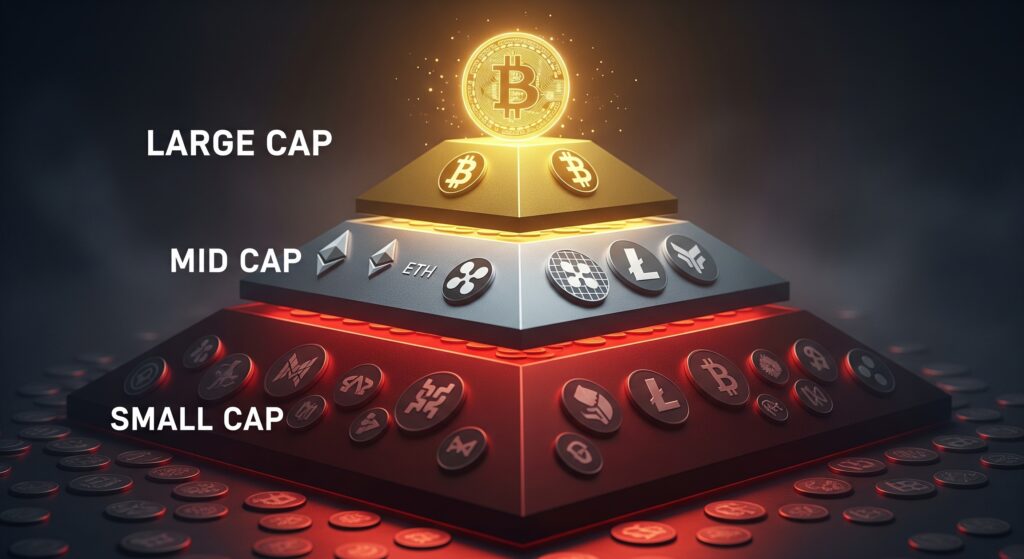
Large-Cap — $10 billion and above
This is Bitcoin territory. Ethereum territory. These coins have been around long enough to survive multiple crashes, regulatory scares, and full-on market meltdowns. By mid-2025, Bitcoin alone was sitting at a market cap of over $1.6 trillion. That’s not a coin — that’s an asset class.
If you want to understand where Bitcoin’s price might be heading next—and what levels traders are watching—go read the Bitcoin price prediction for 2026
Large-cap coins don’t usually 10x in a month. But they also don’t disappear overnight. If you’re the kind of person who checks your portfolio and immediately needs anxiety medication, start here.
Mid-Cap — $1 billion to $10 billion
This is where things get genuinely interesting. Mid-cap coins have already proved they’re not going anywhere, but they haven’t fully grown into their potential yet. Think of them like a startup that just landed its Series B—a real product, real users, but still a lot of runway ahead.
More risk than large-cap. More upside too. This is where I personally spend most of my time researching.
Small-Cap and Low Market Cap Crypto — Below $1 billion
I’m not going to sugarcoat this one.
Low market cap crypto is exciting. I know someone who turned $800 into $40,000 in three months on a small-cap play. I also know someone who lost $6,000 on a project that looked identical — same white paper energy, same Telegram hype, same chart pattern.
The second one was a rug pull. The difference between those two outcomes wasn’t luck. It was research. We’ll get into that in a second.
Market Cap vs. Price—Let Me Kill This Debate Once and For All
This is the thing I wish someone had just said to me clearly on day one.
Price is what one coin costs. Market cap is what the whole project is worth.
Here’s a quick example that makes it stick:
- Coin A: $1,200 per coin. Market cap: $400 million.
- Coin B: $0.04 per coin. Market cap: $9 billion.
If someone asked you, “Which one has more room to grow?”—your gut says Coin A because it’s “smaller.” And in this case, your gut is actually right. But most people look at that $0.04 price tag and think that’s the cheap one.
That’s the confusion; market cap vs price clears up instantly.
A coin’s price means nothing in isolation. You have to know the full picture—how many coins exist, how many are circulating, and what the total value of the project actually is. Once you get that, you stop chasing low-priced coins for the wrong reasons.
There’s a Number Inside the Number—Bitcoin Dominance
Okay, here’s one most people skip, and I genuinely think it’s one of the most useful signals in crypto.
Bitcoin dominance is the percentage of the total crypto market cap that belongs to Bitcoin alone.
So if the total crypto market cap is $3 trillion and Bitcoin’s market cap is $1.8 trillion, Bitcoin dominance is 60%. Why does that matter to you?
Because it reflects the market’s mood. When Bitcoin dominance is high, it means investors are playing it safe. Money is piling into the most trusted, most established asset. Everyone’s cautious.
When Bitcoin dominance starts falling, it means capital is rotating out of Bitcoin and into altcoins. People are feeling confident, maybe a little greedy. That’s often when altcoin season starts—which is when mid- and small-cap coins can run hard.
And here’s the macro layer: when central banks raise interest rates, or there’s broader economic uncertainty, Bitcoin dominance usually climbs because people flee to “safety” even within crypto.
Circulating Supply, Total Supply, Max Supply — What’s the Difference?
I know, I know—three terms that sound like the same thing. Bear with me because this one actually matters a lot when you’re evaluating newer coins.
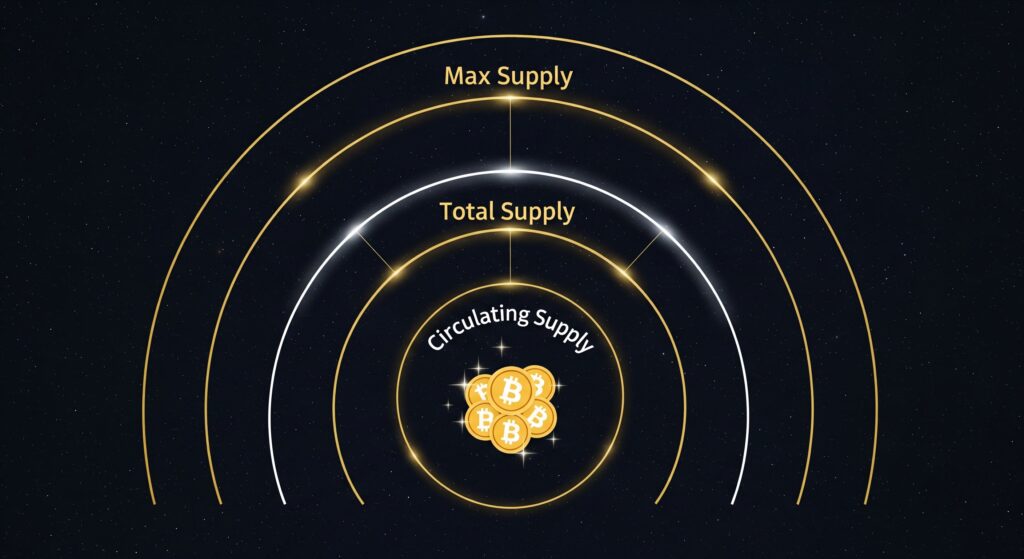
The circulating supply is the number of coins available and trading in the market right now. This is what goes into the market cap formula.
The total supply is all coins that exist—including ones locked up, reserved for the team, or not yet released.
Max supply is the hard ceiling. The absolute most that will ever exist.
Bitcoin’s max supply is 21 million—coded into the protocol and will never change. By mid-2025, about 19.89 million of those were already in circulation. That engineered scarcity is a big reason Bitcoin holds value the way it does.
Now here’s the part most people miss: Fully Diluted Valuation (FDV).
FDV is what the market cap would be if every single coin that were ever to exist were already in circulation. If a coin’s FDV is 15x its current market cap, that means a huge amount of supply is still coming. And when that supply hits the market, it pushes prices down.
Before you invest in any newer project, check the FDV. If it’s wildly higher than the current market cap, ask yourself: who’s holding all those locked tokens, when do they unlock, and what happens to the price when they do?
Low Market Cap Crypto — The Real Talk
Alright, I want to be straight with you here because most content out there is either “low-cap coins are the way to get rich” or “they’re all scams.” Neither is fully true.
Low market cap crypto moves on narrative and hype, not fundamentals. That’s just reality. A whale — someone with millions — can move a $5 million market cap coin by throwing in $100,000. The chart goes vertical. Social media lights up. FOMO hits. You buy. They sell. You’re holding the bag.
I’ve seen it happen to smart people. Genuinely smart people.
But I’ve also seen low-cap plays go absolutely parabolic for people who did the work. Here’s what separates those two outcomes:
- Check liquidity first. If daily trading volume is $50,000 on a $50 million market cap coin — that’s a red flag. You might not be able to sell when you want to without tanking the price yourself.
- Read the tokenomics. When do locked tokens unlock? Who holds the biggest wallets? Is the team doxxed?
- Look for real utility. Does this coin actually do something? Is anyone using it outside of speculation?
- Size your position honestly. Only put in what you’d be genuinely okay losing. Not “I can handle losing this,” okay. Actually okay.
The Total Market Cap — And What $3.95 Trillion Actually Tells You
The global crypto market cap hit an all-time high of over $4 trillion in July 2025. Let that land for a second.
An asset class that didn’t exist 15 years ago now has a total value bigger than most national stock exchanges.
That doesn’t make crypto “safe.” The volatility is still real. But what it does tell you is that this market has moved well past the “early experiment” phase. Institutional money is in here. Pension funds are allocating. Sovereign wealth funds are watching.
When the total market cap is rising, it means net money is flowing into crypto. When it’s falling sharply, capital is leaving — either moving to cash or rotating into safer assets like bonds. Watching this number gives you a macro view of whether the tide is coming in or going out.
And macro matters. When inflation runs hot, and central banks get aggressive with rates, money leaves risk assets, including crypto. The total market cap reflects that in real time.
How I Actually Use Market Cap Before Touching Any Coin
Not theory. This is literally my process.
First—I check what bucket it’s in. Large-cap, mid-cap, or small-cap? That one answer tells me immediately how much of my portfolio I should even consider putting here and what kind of risk I’m taking.
Second, I compare within the same category. Comparing Bitcoin’s market cap to a $10 million altcoin is pointless. I compare Ethereum to Solana. I compare two DeFi coins in the same cap range. Context only comes from comparing like with like.
Third—I check FDV vs current market cap. If FDV is 8x the current market cap, I want to understand where all that new supply is coming from and when it hits.
Fourth — I look at whether market cap has been growing because price is rising or because supply is inflating. Those are two completely different stories. One means demand is real. The other means the project is printing tokens.
Fifth — I check Bitcoin dominance. High dominance means the market is defensive. Low dominance means risk appetite is back. This tells me whether I’m in a market that rewards bold moves or one that punishes them.
One Last Thing — And This Is Important
Market cap is powerful. But it’s one lens, not the whole camera.
It won’t tell you about a project’s team, its product, its community, or whether the whole thing is held together with duct tape and hopium. It won’t tell you about real liquidity or whether the order book is thin enough that a single sell order crashes the price.
Think of market cap as the first filter — the thing that tells you what game you’re even playing before you decide to sit down at the table.
Okay, So Where Does This Leave You?
Here’s the thing. You now know more about market cap than 80% of people who call themselves crypto investors.
You know the formula. You know the difference between market cap and price. You know why low-cap coins move the way they do. You know what circulating supply and FDV mean and why they matter. You know how to read Bitcoin dominance as a macro signal.
That’s not small. That’s the foundation everything else gets built on.
The people who consistently do well in crypto aren’t the ones who found the cheapest coin on the list. They’re the ones who understood what they were actually buying into—the real size, the real weight, and the real story behind the number.
Now you’re one of those people.

Ammar Malik is an independent digital asset researcher and the founder of AmmarMagazine. He specializes in analyzing on-chain security and evaluating technical tools. Through clear, objective crypto resources, Ammar Malik delivers accessible Web3 education to help everyday users navigate the market safely.